Under a false name

Summer in Millhaven hung like a damp cloth over everything.
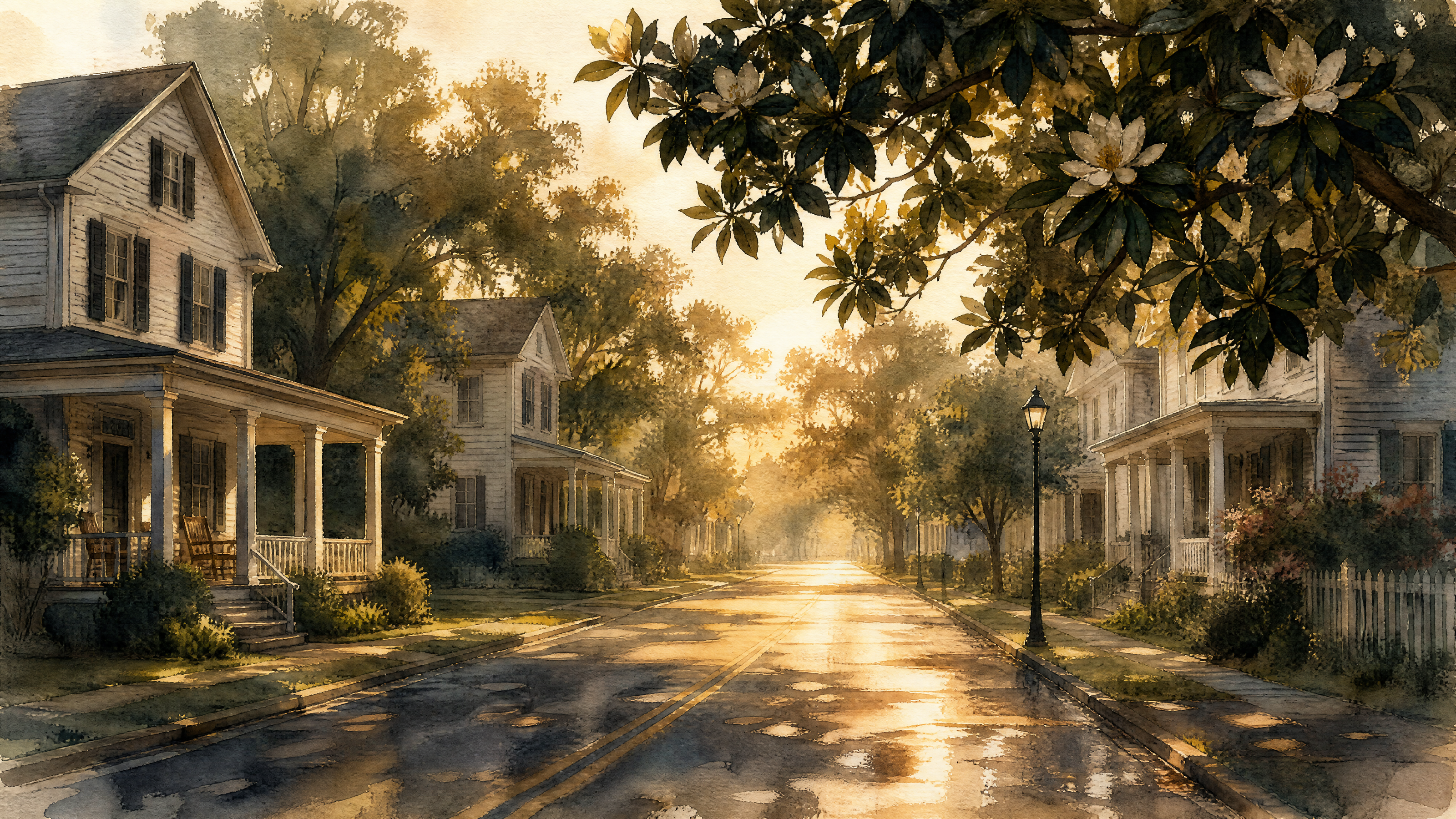
Clara Voss had gotten used to it—the heat that shimmered on the asphalt by eight in the morning, the cicadas that never stopped at night, the white wooden houses with their covered porches that all looked the same and yet had something comforting about them. She had gotten used to many things since moving. To the dialect of the people in the supermarket. To the silence that sounded so different from the silence of the city. To a life that wasn't hers.
What she didn't get used to: the man at the end of the street.
He had moved in three weeks ago. It was a Saturday; she was cleaning the windows near the terracotta pots on the porch and watched him unload boxes from a truck—alone, efficient, no movers, no friend, not a single person helping. The first thing she noticed: he didn't talk to the neighbors, who, of course, immediately appeared, with plastic containers full of banana bread and curious questions. He nodded, smiled exactly once, and was gone back into the house before anyone could say anything.
The second thing she noticed: how he paused when their gazes briefly crossed.
Not like someone looking at a woman. Like someone checking if they'd been seen.
Clara turned around and folded the chamois cloth.
She was a bookkeeper. She worked from home for three small businesses in two different states, and her life unfolded in columns: income, expenses, balance sheets that always had to balance. That was the good thing about numbers. They didn't lie, and they didn't demand explanations. Clara liked that. She liked order. She liked predictable days and evenings, sitting on her porch, drinking cold tea, and listening to the silence, which here was different from elsewhere—thicker, more alive, full of insect sounds and occasional dog barks.
She liked that Millhaven wanted nothing from her.
She only learned his name a week later, at the mailbox.
"Ethan Marsh," he said, without her asking. His voice was deep, slightly hoarse, like someone who doesn't talk much and therefore does it well regardless. He extended his hand. Clara shook it, feeling the hardness of his palm, calluses in places that didn't fit a person who had just moved from the city.
"Clara Voss."
"I know." He lifted the mail a little. "Accidentally ended up in my box. Yesterday."
She saw the letters. Two. One with her address, and she briefly wondered why he hadn't just put them in her mailbox, but then he was already moving on, across his lawn, hands in his pockets, and she was left standing with her letters and the feeling that something about the conversation hadn't been quite right.
She could have left it at that. She was good at leaving things at that.
Except: Ethan Marsh wasn't good at not being noticed.
He was noticeable, in a quiet way that was harder to ignore than any loud way. He was noticeable because his lawn was always mowed, but never at a time when the neighbors saw it. Because he never visited the same supermarket twice in a row—she noticed this because she always went to the same one, Wednesday, eight in the morning, and saw him there one Wednesday and at the other, two miles away, on a Friday. Because sometimes in the evening he sat in his car, engine off, no lights, just there—she saw it when she cleaned the kitchen, from the back of the house. Because when he laughed—once, waiting for the garbage truck, about something Old Gerald had said—for a second he looked like someone who had caught himself.
Clara Voss was not an emotional person. At least, that's what she told herself. She had a marriage behind her that had failed so quietly that both could breathe a sigh of relief afterward, and she had spent two years in a city that had never truly embraced her. Here in Millhaven, she had resolved to want nothing. No drama, no complications, no person who took up too much space.
And yet: Ethan Marsh took up space.
Not intrusively. Not even consciously, as far as she could tell. But he was there—at the end of the street, by the mailbox, sometimes in the evening on his porch, a glass in his hand, gazing at the garden as if he saw something others didn't.
One Thursday evening, he came over.
Clara was sitting on her porch with the tax documents of a restaurant owner from Atlanta who couldn't separate his utilities from his merchandise purchases, drinking her tea, when she heard his footsteps on the gravel. She didn't look up.
"Excuse me." He stopped at the bottom of the porch stairs, no closer. As if he knew that entering was a question, not a given. "I have a favor to ask."
She placed the document on the table. "And that would be?"
"Your Wi-Fi password."
She looked up. He stood in the last light of the evening, which down here in the South was so golden that it made everything a little more unreal, and looked like someone who knew exactly how strange the request sounded. His face was calm. Controlled, in a way Clara immediately recognized because she mastered it herself—the face you make when you don't want something to be seen.
"My own isn't set up yet," he said. "Technician comes next week."
"That's a month after you moved in."
"I didn't urgently need it."
She looked at him. He looked at her. The cicadas did their thing.
"I'll write it down for you," she finally said, standing up.
He came up the stairs—three steps, no more—and waited while she went through the glass door into the house. She wrote the password on a Post-it, found upon returning that he hadn't sat down, even though she had two chairs on the porch. He stood. Didn't even lean. Someone who had learned to leave no trace.
She handed him the note. He folded it without looking at it.
"Thanks."
"You're welcome."
He nodded once and turned to leave, and Clara opened her mouth, without quite knowing why.
"You didn't really come here for the Wi-Fi, did you?"
He paused. Only a second, barely measurable. Then he turned around, and there was something on his face she couldn't quite place: not a smile, not surprise, rather something like recognition. As if he had been testing something.
"Good night, Ms. Voss."
And he was gone.
Clara stood on her porch, listening to his footsteps until the gravel was quiet again. The document from Atlanta lay on the table, the numbers waited, and the evening smelled of cut grass and warm rain.
She was good at analyzing things. Income, expenses, patterns that repeated until they told a story, whether you wanted it to or not.
Ethan Marsh was a pattern she couldn't read.
That bothered her more than anything else.
She slept poorly that night, lying on her back, listening to the air conditioning kick on and off at regular intervals, and wasn't thinking about him—at least, that's what she told herself. What she was really thinking was: the calluses on his hands. That he had waited a day to bring the letters. That his car was an inconspicuous gray Toyota, the kind that leaves no impression. That he could have asked for her Wi-Fi password from a distance. With a note. By knocking on the door.
Instead, he had come to her porch at eight in the evening and let her watch him fold a Post-it without reading it.
Because he didn't need the password at all.
Because he wanted to know what she did when someone got too close.
The realization settled in her like a splinter, only found days later.
On a Friday, eleven in the morning, a black Suburban turned onto Maple Street. No local license plate, no magnetic stickers, nothing. It drove slowly—not the slowness of someone looking for an address, but the slowness of someone counting. Clara watched it from the kitchen window, coffee cup in hand, and noticed that it briefly paused in front of Ethan Marsh's house, without stopping, and then drove on.
She waited.
Twenty minutes later, it turned in again, this time from the other side.
Clara put down her coffee cup.
She was not a fearful person. But she was observant. And observant people know when something is wrong—not loud, not dramatic, but quiet, like a wrong note in a melody you know by heart.
She reached for her phone and typed: *Black Suburban, twice in ten minutes. No license plate seen.*
Sent the message to no one. Deleted it again.
What would she have written? To whom?
Ethan Marsh was at her front door twenty minutes later.
He didn't knock. He just waited—she saw the shadow behind the frosted glass before she opened. He wore a dark blue jacket, though it was thirty-five degrees Celsius, and looked like someone who had been under pressure for too long and learned not to show it.
"You saw it," he said. No question mark.
"The Suburban? Yes."
He nodded. Something in his face changed, barely perceptible—as if a calculation was complete. "May I come in?"
She stepped back. Let him in. He stopped in the hallway, surveying the room with a gaze too fast for curiosity and too systematic for indifference. Windows, doors, distances—she knew that look now, because she had learned to recognize it.
"Who are you, really?" she asked.
The silence that followed was not uncomfortable. It was heavy.
"Someone who made a mistake," he finally said. "Two years ago. And who thought two years was enough."
He didn't sit down, but he leaned against the wall next to the hall cabinet, and for the first time since she knew him, he looked like someone who didn't quite know how much space he was allowed to take up. That was the most vulnerable thing she had ever seen in him—that one pause.
"Witness protection," she said. Not as a question.
He looked at her. "Now you know."
"How long?"
"Long enough to think it was over." A short pause. "It's not over."
Clara thought. Outside, somewhere, stood a black Suburban, and inside were people paid to find a man who had been someone else for two years. And this man stood in her hallway, jacket despite the heat, eyes that looked at her in a way she hadn't been able to place for three weeks.
"What did you," she said slowly, "really want from me? From day one."
He opened his mouth. Closed it. Then: "I wanted to know if you're the kind of person who notices things. If you can keep silent." Another pause, and beneath it was something he didn't say, but she heard anyway. "And I wanted to be near someone real."
Clara stood in her hallway, barefoot on the wooden floor, which was always cool in the morning and had stored the day's warmth by afternoon, and felt exactly what she hadn't wanted to feel for three weeks: that this man had found a gap in her that she had thought was walled up.
"That's a dangerous thing you just said."
"I know."
She looked at him. He looked at her. The air conditioning clicked on.
"What happens now?" she asked.
"I call my contact. They'll move me." He said it soberly, but his jaw worked briefly. "Tonight, probably."
*Tonight.* The word landed differently than it should have. Clara took a step towards him—not far, not as a gesture, but simply closer, because the hallway was too wide for what stood between them. He remained still. Didn't move, but his eyes changed, becoming darker, more alert, in a way that had nothing to do with checking anymore.
"Ethan." Perhaps not his real name, but the only one she had.
"Clara."
She placed a hand on his chest—flat, palm on fabric, and beneath it, she felt his heartbeat, faster than his face admitted, and he allowed it, this one crucial time, not wanting to leave no trace: he let her hand lie there and raised his own, placed it over hers, not to hold it, but to tell her that he knew.
That he felt it too.
He didn't kiss her right away. He looked at her first, so close that she caught the scent of his skin—heat, soap, something darker beneath—and they both knew this was a goodbye before it had even begun, and perhaps that's why none of it was cautious.
When he found her mouth, there was no hesitation. It was an arrival. His arm pulled her close, his hand on her neck, and Clara allowed what she had dismissed for three weeks—that this man, whoever he was, felt like something she hadn't sought and yet fit, as precise and unbidden as a number that balances a ledger.
They spent the afternoon in the shade of her bedroom, the blinds half-closed against the light that still streamed through the slats, drawing stripes on his shoulder blade as she lay beside him, trying not to think. His body was full of scars she didn't ask about, and full of a silence they both shared. When he spoke—once, softly, into the pillow—he said: "My name is Daniel. If you wanted to know."
She didn't repeat it. But she didn't forget it either.
Around seven in the evening, he put his jacket back on. She walked him to the door. He stopped on the top porch step, as he had the first time, and turned again.
"You shouldn't sleep at home tonight. Just in case."
"I'm going to Linda's, three streets over. She doesn't ask many questions."
He nodded. Something in his gaze was so strangely calm—not empty, the opposite. Full, in a heavy, precise way.
"Clara." He paused. "Thank you. For just—being you."
She said nothing. Sometimes that's the most honest answer.
She watched him until he was out of sight. The evening smelled of the rain that had briefly fallen at four, and the cicadas had started again, and somewhere at the end of Maple Street stood a car that wasn't hers.
She stayed on the porch for a while, longer than necessary. The cicadas continued, indifferent and reliable, and that was comforting in a way Clara wouldn't have expected.
Around nine o'clock, she packed a bag. Toothbrush, two blouses, the tax documents from Atlanta, because the restaurant owner still couldn't separate his receipts and the deadline was at the end of the week. That was the kind of person she was. She packed the work.
At Linda's, she drank white wine and answered three questions with half-sentences, and Linda, who had lived in Millhaven for thirty years and had learned when to stop asking, simply refilled her glass.
In the night, shortly after two, she heard from the guest bed a car driving slowly down the street outside. Once. Only once.
After that: silence.
Three weeks later, a moving truck was in front of the house at the end of Maple Street. Two men loaded boxes—not many, but more than one person could have carried alone. Clara watched it from the kitchen window, coffee cup in hand, just like before.
The house was occupied by a couple from Tennessee. He was a teacher, she a veterinarian. They didn't bring banana bread because they ate it themselves, on the way, and the first thing they said was that the street was so quiet.
Clara liked them.
In October—a gray Tuesday, the first cold of the year—she found a letter in her mailbox with no sender. No postmark, no return address. Just an envelope, neatly sealed, her name in a handwriting she didn't know and immediately recognized.
Inside: no letter. Just a business card, blank, and on the back, with a ballpoint pen whose ink had slightly smudged:
The balance is correct.
She stood by the mailbox for a long minute, the envelope in her hand, the cold on her face, and then she did something she hadn't done in months: She laughed. Short, quiet, to herself.
Then she went inside and made tea.
The numbers waited. The cicadas were silent now, because it was autumn. The silence here sounded different from the silence of the city—thicker, more alive, full of things unsaid and yet remaining.
Clara Voss was not an emotional person.
At least, that's what she told herself.