Midnight at the Vet Clinic

The box had been made from an old pair of winter boots — Mia saw that immediately from the faded shoe size markings on the outside and the hastily punched air holes someone had poked into the cardboard with a ballpoint pen. No care, but determination. Two different things that didn’t always go together.
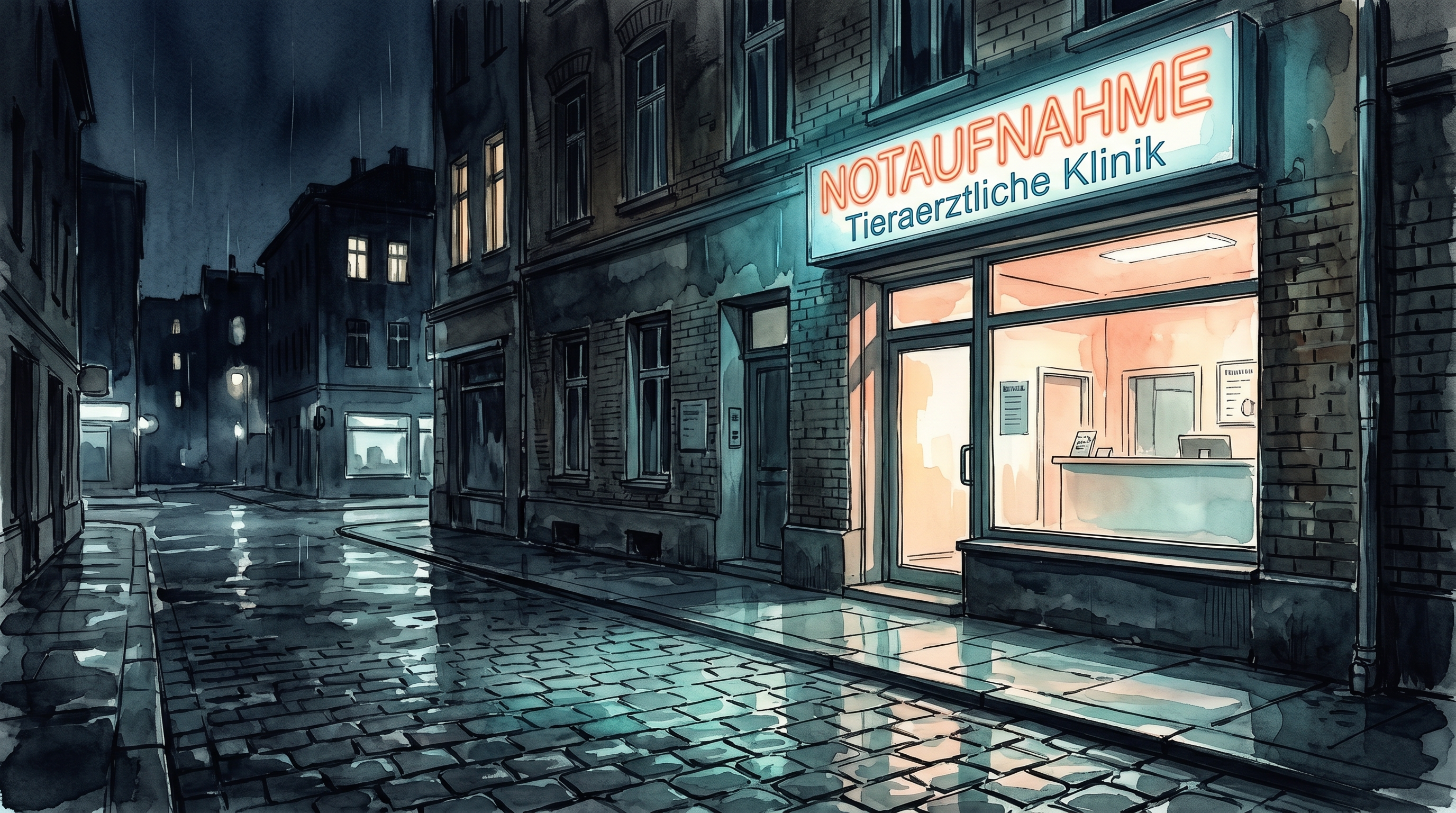
It was eleven minutes to midnight. The neon light above the reception desk hummed at a frequency she had known for years and could never get rid of — a toneless white noise that devoured the silence of the empty waiting room like dampness eats old wallpaper. The paint on the third row of tiles from the left had peeled again. Mia had noticed it this morning and had meant to call the caretaker. She had forgotten again.
The man carrying the box was tall enough that the front door would have almost brushed him if he hadn't held it open with his elbow. He wore a dark jacket, one shoulder damp with something — dew, perhaps, or street water — and he held the box with both hands as if carrying something fragile. Which he was.
Mia was already on her feet even before he opened his mouth. There was a specific way people held a box if there was something alive inside — a slight corrective movement in the arms, an unconscious balancing of every movement from within. She recognized it instantly.
"Fox," he said. Not a sentence. Just the word.
"Put him here." Mia pointed to the examination table and was already pulling on gloves as she spoke. The man set the box down — carefully, controlled — and then took half a step back, as if he was done. As if he had done his part and others could take over now.
She opened the box flap. The fox lay on a rolled-up jacket — old fleece, olive green, clearly not intended for the box, but put in because someone had decided it was needed. The animal was young, estimated eight to ten months old, lying on its side, one hind leg at an angle that was wrong. Its breathing was shallow but even. No visible external bleeding.
"Where did you find him?"
"Sidewalk. Over on Peachtree Mill Road."
"How long had he been there?"
"I don't know. I just happened to be passing by."
Mia was already working — pulse, reflex, pupillary response, careful palpation along the spine. She asked questions, as she always did, without looking up: mechanically, calmly, so that the other person's silence had no room to settle.
"Did he move when you picked him up?"
"Briefly."
"Make any sounds?"
"No."
"Did you touch him directly or use something in between?"
A brief pause. "The jacket."
She nodded, without comment. The bandage on her index finger — the third this week, because the staples on the form board always aimed at the same spot — pulled slightly as she palpated. She ignored it.
Then she tried to look at him.
He looked past her. Not intentionally rude, but as if he had decided her face was not a necessary part of this situation. He looked at the fox, at the tiles, at the humming neon light somewhere above them. His hands hung by his sides, his weight shifted slightly back, as if he had already half-left.
"What's your name?"
Another pause. Longer this time.
"Jonas Krell."
"Mr. Krell." Mia straightened up and took off her gloves. "The animal likely has a fracture in its right hind leg, possibly a concussion. I will X-ray him and stabilize him. I can't tell you anything more specific tonight."
He nodded. That was all.
She took a business card from the holder on the counter — the plastic was cracked, the holder itself had been in service too long — and placed it on the shelf next to the box. Not in his hand. Next to the box.
"I'll call if he makes it through the night."
Jonas Krell looked at the card. Then he picked it up — with a swift, strangely precise movement — and put it in the inside pocket of his jacket, without turning it over, without reading it. As if the content was already known. Or as if it didn't matter who had written it.
He said nothing more. Turned around. The door closed softly behind him — quietly, almost gently, as if he had practiced leaving no trace.
Mia stood for a moment after the glass fogged up — her breath against the warmth that the cold outside didn't know. Then she turned and went back to the fox.
For now, she called him Schönhauser. Because foxes needed names, even if you didn't keep them forever.
The X-rays showed what she had suspected: a spiral fracture in the right femur, no spinal involvement, the concussion mild enough to be treated expectantly. She worked until shortly after two in the morning, in silence, filled only by Schönhauser's muffled breathing and the hum of the cooling units. When she was finished — the leg splinted, the animal placed in a soft, warm enclosure, monitoring set up — she washed her hands three times, because she always did it three times, and rubbed the tired knot out of her left shoulder that hadn't wanted to go away since Tuesday.
She called at 7:42 AM. Jonas Krell picked up on the third ring.
"He survived the night," she said. "Spiral fracture in the femur. He's stable."
A brief pause. "Good."
"You can come by if you like. But it's not an obligation."
"I know."
That was the end of the conversation.
He didn't call back in the following days. He didn't write. Mia wore that like something neutral — a fact, not a meaning. Schönhauser ate again on the third day, extended his hind legs on the fifth, tried to sit on the seventh and failed with a certain dignity. Mia documented everything, because that was her job, and because it helped her keep things in categories: What she could do. What she had to wait for. What she should let go of.
---
A week after the night with the box — exactly one week, a Tuesday afternoon that smelled of autumn rain and the coriander chicken from the deli three doors down — the practice door opened again, and Jonas Krell stood in the reception area.
He wore the same dark jacket. Or a similar one. Mia only noticed this in hindsight, because she was in the middle of a conversation — Til, her colleague from the shared practice upstairs, leaned against the counter with a coffee cup and was explaining something to her about a podcast that was supposedly going to change her life. He said it with the slight excess of attention that meant he wasn't really interested in the podcast.
Jonas paused briefly. Mia saw it out of the corner of her eye — saw how he assessed the situation, how something in him re-sorted itself, quickly and silently, like someone who had learned to read rooms in seconds.
He was carrying a pot. Ceramic, dark green glazed, with a small plant whose leaves looked slightly withered at the edges, as if it hadn't survived the journey completely unscathed. Herbs. Peppermint, Mia recognized a moment later, when he placed the pot on the counter — a concise, ceremonial movement that didn't fit the man who had rushed in a week ago with a shoe box.
"For the fox," he said. "If he likes it."
Til turned around and eyed Jonas with the relaxed curiosity of someone to whom social situations could fundamentally do no harm. "Do foxes like peppermint?"
Jonas didn't answer. He looked at Mia — directly this time, briefly, like a calibration attempt — and then his gaze was gone again, and he had already turned away.
"Mr. Krell—" Mia took a step towards him, but Til was still half in her way, and she had to dodge for a moment, and that moment was long enough.
The door clicked shut. Gently again. As if Jonas Krell had made it a habit — silent departures that still left something in the room.
Til looked at the closed door. "Friend of yours?"
"No." Mia reached for the pot. The soil was fresh, moist, with a faint compost smell underneath. "Someone who brought in an injured animal last Tuesday."
"And now herbs."
"Apparently."
She stepped into the stairwell, because her first impulse demanded it and her second was too slow. The stairwell was dimly lit — one of the bulbs had been broken for weeks — and smelled of the wood wax the building management applied to the stairs, and of the persistent mold in the corner under the mailbox board. Mia stopped on the second step and listened. Nothing. Just the silence of the stairwell, wrapping itself around her like something familiar that you no longer explained to yourself.
Her breath still hung in the air when she turned and went back.
She placed the peppermint pot on the windowsill next to the recovery cage where Schönhauser was sleeping. The animal didn't stir. The pot stood slightly askew, because the glaze had a tiny crack on one side, making it wobble. Mia corrected it twice, then let it be. Some things couldn't be permanently straightened.
The next three weeks followed Schönhauser's recovery protocol. Jonas Krell called twice — briefly, factually, with pauses that became shorter the second time. He asked if the fracture affected blood circulation. He asked if foxes developed less stress in foster care than in a shelter. Both questions were precise. Both presupposed that he had already done his research.
Mia answered them directly. She noticed that it was easier than it should have been.
He came once more — two weeks after the peppermint pot, on a Friday lunchtime when the practice was quiet for an hour. This time he stood in front of the cage and looked at the fox, who looked back at him with the equanimous distrust of an animal that had not yet come to a judgment. Mia leaned against the doorframe and said nothing. He said nothing either. The silence between them remained — and at some point, without anyone doing anything, it was different than before.
When he left, he turned around briefly. Not to say anything. Just that.
—
The evening Schönhauser was released was a Thursday, and Mia was there.
They had a partner on the outskirts of Heron Falls — a spacious, wooded area managed by a small wildlife rescue station. The release was not a big event: a transport box opening, an animal pausing for a moment, assessing the situation, and then running. No hesitation in its departure. Just that brief stillness before — and then gone.
Mia stood in the clearing for a while. The evening smelled of damp leaves and the smoke of a distant fire she couldn't see. She cycled back to the practice — half an hour, wind from the side, an autumn evening cold enough to keep her awake, and beautiful enough to make her take a detour.
The practice was closed when she arrived. She unlocked the door, placed her bicycle in the entrance, and left the light in the treatment room off. Only the small lamp on the reception desk cast a low glow on the white walls. The recovery cage stood empty. The door was open. Mia didn't close it, because she liked the idea that something empty could also be open.
The knock came as she was taking off her jacket.
Not the hurried knock of an emergency room, not the hard pounding of someone who had waited too long. A brief, quiet knock, twice, that waited.
She knew before she opened it.
Jonas Krell stood at the door, holding nothing in his hands.
This was the first time she had seen him without anything — without a box, without a pot, without the small pretext that had framed the other visits. He wore a darker version of his usual jacket, the left lapel turned up, the right not — a detail that was clearly unintentional and yet told her something.
"I know you're closed," he said.
"Yes." Mia took half a step aside. Not far — just enough to signal that the door remained open.
He stepped inside. Stood close to the entrance, looked at the empty cage. The open cage door. Then at her.
"Today."
"Today," she confirmed.
He nodded. A long pause — the kind of pause in which Jonas Krell seemed to be thinking, but not in the way other people thought, with audible internal deliberation, but as if he just had to wait for something he had already decided.
"I wanted to say—" He broke off. Started again. "I didn't want to just bring something else by."
Mia watched him. In these weeks, she had learned that Jonas Krell sometimes placed sentences like pieces of furniture: precisely positioned, without ornamentation, expecting the space around them to carry the meaning.
She let the sentence stand. This was new — in the past, she would have filled in, bridged, opened a door to the silence. But she had learned that Jonas Krell didn't need bridges. He needed time.
"I wanted to ask," he said finally, "if this also goes in another direction."
Mia knew what he meant, and at the same time knew she wouldn't let him get away with that vagueness. Not tonight. "Which one?"
He looked at her. No evasion this time, no calibration attempt. Just that direct, calm gaze that contained more than all the sentences he had ever placed.
"Toward you."
The small lamp on the counter cast a circle of light on the floor between them. Mia felt the bandage on her index finger, the slight pull of the adhesive against her fingertip — that familiar little signal that had accompanied her for weeks. She took two steps. The distance between them shrank to something that could no longer be ignored.
"It's been going in that direction," she said. "For a while."
Jonas exhaled — not a sigh, no feigned relief, but the sound of someone finally letting go. He raised a hand and placed it on her cheek, with the care that characterized everything about him, and Mia closed her eyes briefly, because the contact was warmer than expected — and because she had realized that she had been expecting exactly that for longer than she had admitted to herself.
Then he kissed her. Not hastily, not hesitantly — just as he set down boxes and placed sentences, with a calm that was not a lack of intensity, but the opposite. Mia placed her hand against his chest, against the turned-up lapel that was still on the wrong side, and didn't let him step back.
The practice smelled of disinfectant and compost earth and the faint trace of peppermint that still hung in the air from when the pot had stood on the windowsill. The neon light in the treatment room was off. The cage stood empty and open. Through the window came the muffled hum of the suburb — crickets, a distant car, the silence between everything that was always there in this area.
Jonas pulled back a little — just a little — and looked at her, with an expression she didn't yet know and which, for that very reason, meant something to her.
"The fox is gone," he said.
"Yes."
"And you?"
Mia looked at him — this silent, difficult, precise man who had brought an injured fox in a shoebox and accidentally brought himself with it — and she smiled, for the first time that evening, a smile that neither overstated nor held back anything.
"I'm still here," she said, and closed the door behind them.