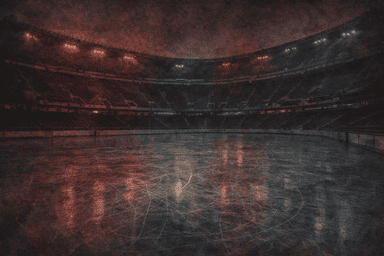
The Ice of Calgary

Calgary, February 1988. The ice smells of nothing that can be described if you don't know it: of cold that has already done its work, of rubber and metal, and of the very specific silence of a hall where no spectators are yet seated.
Diane Okafor-Calloway sat in row twelve of the press tribune at the Scotiabank Saddledome, holding her golden pen the way other people hold something that calms them. Her father had given her the pen when she wrote her first article for the school newspaper. He had said: They can take everything else from you. What you write down with it, they can't. She was fourteen then and hadn't known what he meant. Now, at thirty-three, in a press tribune in Calgary, with minus fifteen degrees outside and an editor-in-chief who had sold her this accreditation as an act of grace, she knew.
The Soviet national team was training on the ice.
Diane had watched many ice hockey games. She knew how bodies moved on the ice: mechanically, efficiently, reduced to the shoulder or the stick. The Soviet players moved differently from American teams, that was known, but what she had never seen well described in an article was this specific quality of collective awareness: as if eleven bodies were parts of a single animal that coincidentally had separate thoughts.
Alexei Nesterov was not part of that animal.
She had his name on the accreditation list, had his statistics, knew he was twenty-seven and the most successful forward on his team that season. What the statistics didn't say: He moved on the ice with a naturalness that was almost rude. Too light-footed for a forward, too little effort for someone under observation. And he was under observation. Diane had identified the two men at the edge of the hall within the first three minutes, too silent for coaches, too attentive for press officers.
She wrote: *Nesterov, 27, LW. Moves like someone who owns the ice. Or like someone who knows he’s losing and doesn’t care.* She crossed out the second sentence. Too personal for a training report. Then she wrote it down again.
Her phone call with Gary this morning had lasted eleven minutes.
He had asked if she had packed enough socks. He hadn't meant it ironically. Gary Calloway was a sincere man, an accountant from Arlington who watched Jeopardy in the evenings and mowed the lawn on Saturdays, and truly loved Diane, in the way one loves someone chosen because they are reliable and quiet. She had said yes, yes, enough socks, and he had wished her well with the voice of a man who doesn't know what the Winter Olympics mean to a woman who has been trying to prove for ten years that she can do more than captions and game reports.
On the ice, someone shouted in Russian. Diane didn't look. She looked at Nesterov.
He was on a training break, standing at the edge, stick loosely in hand, conversing in Russian with a young Canadian with a press pass who looked like someone working for a local sports magazine and probably wanted to interview Nesterov. But Nesterov wasn't being interviewed. Nesterov touched the Canadian's hand, briefly, too briefly for anyone not paying close attention, with just the right pressure that was not an answer but a confirmation. The Canadian, who was twenty-three at most and had red ears, not from the frost, said something Diane couldn't hear. Nesterov smiled. It was the smile of someone who knows exactly what he’s doing.
Then the attendant came.
The man wore a dark coat that seemed out of place in this context, too stiff, too urban, and he spoke to Nesterov in Russian with the voice of someone who doesn't ask questions but corrects positions. Nesterov released the Canadian's hand, a fraction too late for coincidence, and followed the man without haste. The Canadian watched him go. Diane watched the Canadian go.
She wrote nothing.
She held the pen over the pad and left it there, in the air, until the ice grew loud again and the training resumed.
*This is a story*, she thought.
In the press room of the Palliser Hotel, two hours later, it smelled of cigarette smoke and coffee that had been in glass carafes for hours and had slowly turned bitter. Diane sat at a table in the corner, her notebook open, organizing what she had seen. She didn't write sports. That was the problem with her career, and she knew it.
She had received the note on the morning of the sixth day, through the press assistant, whom she recognized as the same one whose ears had been red during practice. He had pressed a folded piece of paper into her hand, as casually as one hands someone a pen, and left without looking her in the eye. The handwriting on the paper was neat, almost formal: a room number, a time, an address she didn't need to look up on the city map. Regency Hotel, 4th Avenue SW. Nine o'clock in the evening.
Diane had read the note three times and then slipped it into the back pocket of her notebook, between business cards and a newspaper clipping from 1985 that she still carried with her because the author had written a sentence that had never left her: *The story you're afraid to file is the only story worth having.*
She had called Gary at half past six. He had talked about dinner with colleagues, about a new Italian restaurant in Georgetown. His voice had sounded as always: steady, reliable, a metronome. She had listened, and at the same time had the room number in her head. Twenty-seven. The same number as Nesterov's age, which was not a sign and yet remained.
She had taken her notebook when she left. She had told him it was an interview.
The Regency Hotel smelled of the carpet that was always the same in North American business hotels of this category: synthetic, compressed, as if it had absorbed too many lives and stopped giving them back. The heating hummed as she walked down the hallway, a deep, constant sound that underscored the silence. Door number twenty-seven. She knocked.
Nesterov opened immediately, which meant he had been waiting, and that made something in her chest tighten. He wore a simple white shirt, untucked, and looked like someone who had precisely calculated how much relaxation was appropriate. His gaze went immediately to the notebook in her hand. He said nothing. He let her in.
The room was small, the bed wide enough for one person who wanted to be comfortable, or for two who didn’t need a particular reason. A chair, a desk, a full ashtray, though Diane didn't believe he smoked. The window looked out onto a wall. The heating worked so hard that the air was dry and she felt the warmth on her skin before she had even taken off her coat.
“Vodka,” he said, offering her a glass. A question that didn't want to be one.
She took it. Drank. The vodka was good, better than anything she would have expected here, and that told her something about him she would rather not have known.
"I have questions," she said in English.
"I know," he replied, also in English, with an accent that was heavy but precise, like someone who had learned a language because he needed it for situations like this. "The notebook is for the questions."
"Yes."
"Then put it on the table."
She put it on the table. She didn't look him in the eye while doing so, because she knew she would have to if she did it now. Then she looked him in the eye.
He looked like someone who had learned to show exactly as much as he wanted to show. And yet there was something he couldn't quite hide: a kind of attention that felt different from the polite concentration of an athlete during an interview. He looked at her as if weighing whether she could bear what he was about to give her.
"You were watching me," he said. "In practice. I saw you holding the pen but not writing."
"I was thinking."
"What were you thinking?"
She could have said: I was thinking, this is a story. She could have said: I watched you and the Canadian and understood what that meant, and I’m still here, even though I shouldn’t have come. Instead, she said: “That you were the only player on the ice who looked like he was choosing to be there.”
Something in his face moved, briefly, barely visibly, and she understood that she had hit on something true, without knowing how.
He came towards her. Slowly, without theatrics, just as he moved on the ice: as if he had the right to and knew it. He took the vodka glass from her hand and put it aside, and then he stood so close that she could smell his skin, warm and faintly of soap, and beneath that, something she couldn’t name but felt in her stomach.
“The interview,” he said softly, “we can do it tomorrow.”
Diane did nothing.
Seconds passed, and she didn't count them, because she had given up control of what mattered and what didn't. His warmth was before her, the scent of his skin, the dry, hot air of the room, the hum of the heater like a heartbeat that wasn't hers. She should have taken the notebook. She should have closed the door behind her and walked down the hall, back to the press room, back to Gary, who was at an Italian dinner in Georgetown and really didn't want to know where she had gone.
She did nothing. And then she did the wrong thing.
She placed her fingers on his collar, at the top of his neck, where the shirt was open, and let them rest there until she felt his pulse beneath the skin, calm and steady like everything about him she had seen on the ice. He didn't move. He waited with the quality of a man who had learned that impatience had never gained him anything. Then he tilted his head and kissed her, without drama, without warning, as direct as everything he did.
His mouth was warm and tasted of vodka and something beneath it, something she couldn’t have described, but which ignited something within her that she hadn’t felt in months. Perhaps longer. She kissed him back, and he let out a short sound, a soft, surprised exhalation, as if he hadn’t known what she would do after all.
It made it different. Sharper. Both hit her at once.
His hands found her waist, then her jacket, which he pushed open and placed on the chair without interrupting the kisses. She leaned against the desk, her back against the wood, pulling him with her, and he came, his hands now on her hips, firm, so that she knew exactly where she was: in a room at the Regency Hotel in Calgary, with a Russian hockey player who kissed her as if she were something he couldn't afford and yet took.
He pulled his shirt out of his pants. She helped him, because her fingers were already on the fabric, and she felt the warmth of his abdominal muscles beneath, the edge of his ribs, the small scars that a life on the ice leaves behind: one on his wrist, one below his left shoulder, which she touched with her thumb, and he allowed it, quietly, with closed eyes, as if being touched was something he rarely knew.
She pulled her top over her head. He looked at her: calmly, focused, just as he saw the gap in the goal on the ice before he shot. Then he placed his hand on her breast, over her bra, and she felt the warmth of his palm through the fabric before he unhooked it and pushed the bra aside. He took his time with her breasts, his hands, his mouth, his tongue on her left nipple, until she clawed her fingers into his hair and sucked in air through her teeth.
He said something in Russian. Softly, almost inaudibly. She didn't ask what it meant.
The bed was narrower than it looked, but no narrower than they needed. Their clothes lay scattered: her skirt on the floor, his trousers over the edge of the bed, her stockings somewhere. He stripped them off her, slowly, from her thighs downwards, and she felt the temperature of his fingertips on her skin, precise and warm.
He kissed her belly, her hips, the inside of her thigh, and she understood where this was leading, and allowed it. His lips on her labia, his tongue, the first direct touch on her clitoris, and she heard herself sigh, loudly and uncontrollably, in a way that never happened with Gary, because Gary didn’t touch her like that, because Gary didn’t know how. Alexei knew. Alexei took his time and listened to her body, the way her hips responded, the way her fingers clutched his hair as she showed him what she needed without saying a word.
She came, her eyes closed, her breath rushing out, hard and complete.
Then he pulled himself over her, and she felt his erection against her hip, and the ache within her that wasn't over, but realigning itself. She put her hand between them and took him in her hand, felt him briefly hold his breath, maintain control, and then relax. He was heavy and warm, and as he slid into her, slowly, with the patience he devoted to everything important to him, she closed her eyes and thought nothing.
That was the strangest thing. Diane Okafor-Calloway, who was always thinking, who even formulated thoughts while falling asleep, stopped thinking. She only felt him.
He moved inside her like someone who knows it's the last time, even if he didn't know it then.
Later, as they lay side by side and the heater was silent because it had turned itself off, and the cold of Calgary slowly crept through the window, he had taken her arm and held her as if holding was a language he mastered better than any other. She had rested her face against his shoulder and had not slept.
The Soviet delegation's farewell party took place in the grand ballroom of the Palliser, three days after the gold medal game, where Diane had sat in the press tribune and watched Alexei leave the ice without once looking at the stands. She didn't know if that had been discipline or intention.
The hall smelled of warm tobacco and the heavy perfumes of the delegation women, of champagne—which wasn't called champagne here—and of the particular seriousness of people who know they are being watched. Diane wore her only formal dress, the dark red one Gary had given her for her thirtieth birthday, and held her notebook under her arm as always, because she never arrived anywhere completely without it.
She saw Alexei immediately.
He stood with a group of officials, the gold medal ribbon around his neck, his jacket correctly tailored, his smile perfectly placed. He looked like someone who had learned to be what the situation demanded of him. Then he saw her, and the smile remained, but something behind it changed: a degree of warmth, a fraction of openness that only someone who knew where to look would see.
She approached him, because one of them had to, and because she was the journalist.
“Congratulations,” she said in English.
"Thank you," he said, also in English, and then, more softly: "I thought you had already left."
"Tomorrow."
He looked at her, calmly, with the attention she had known since the first practice. Around them, people moved, not yet paying them any mind. One of the men in the stiff coat stood ten meters away, speaking into his glass.
Alexei took her hand. Just like that, as if it were the most natural thing, and held it for two, three seconds, long enough for her to feel the pressure of his fingers on her knuckles, warm and firm, the small scar on his wrist against the back of her hand.
"In another life," he said.
Diane looked at him and swallowed what she wanted to say, because it had no place in this hall and no place elsewhere either. She thought of the room in the Regency, of the heater that hummed like a strange heart, of the Russian he had whispered, untranslated. She thought that the Soviet Union, next year, the year after, eventually, would no longer be what it was now, that the world was turning, even if they, here, in this hall, under these chandeliers, did not yet know it. And that Alexei Nesterov would nevertheless remain here, behind a border that shifted or disappeared, and she still couldn't reach him, because what had been between them had never had a place.
She let go of his hand. He let her go.
"To another life," Diane Okafor-Calloway said, and turned, her notebook firmly under her arm, the golden pen in her jacket pocket, and walked back through the hall to the door, without looking back, though she knew Alexei Nesterov watched her until she was gone.