Blackmoor Hall

The frost on the glass had not yet melted when Eleanora stepped out of the carriage.
She felt the December cold through three layers of silk, through the corset that stole her breath, down to that place between her ribs she had long since stopped naming. Blackmoor Hall loomed before her like a promise no one wanted to keep – grey stone, blind windows, a sky as pale as unwritten parchment.
Twelve months. She had twelve months to marry a man she had never seen, or lose everything her father had left her. The will had been clear, brutal in its simplicity: marry Lord Adrian Vane, the son of his oldest friend, or the estate would revert to the Crown.
A punishment, her aunt had said. A final lesson from your father.
Eleanora called it a trap.
The front door opened before she reached the steps. A butler with a face like carved wood bowed, said something about the weather, about the journey, about things she didn’t hear because her attention was already elsewhere.
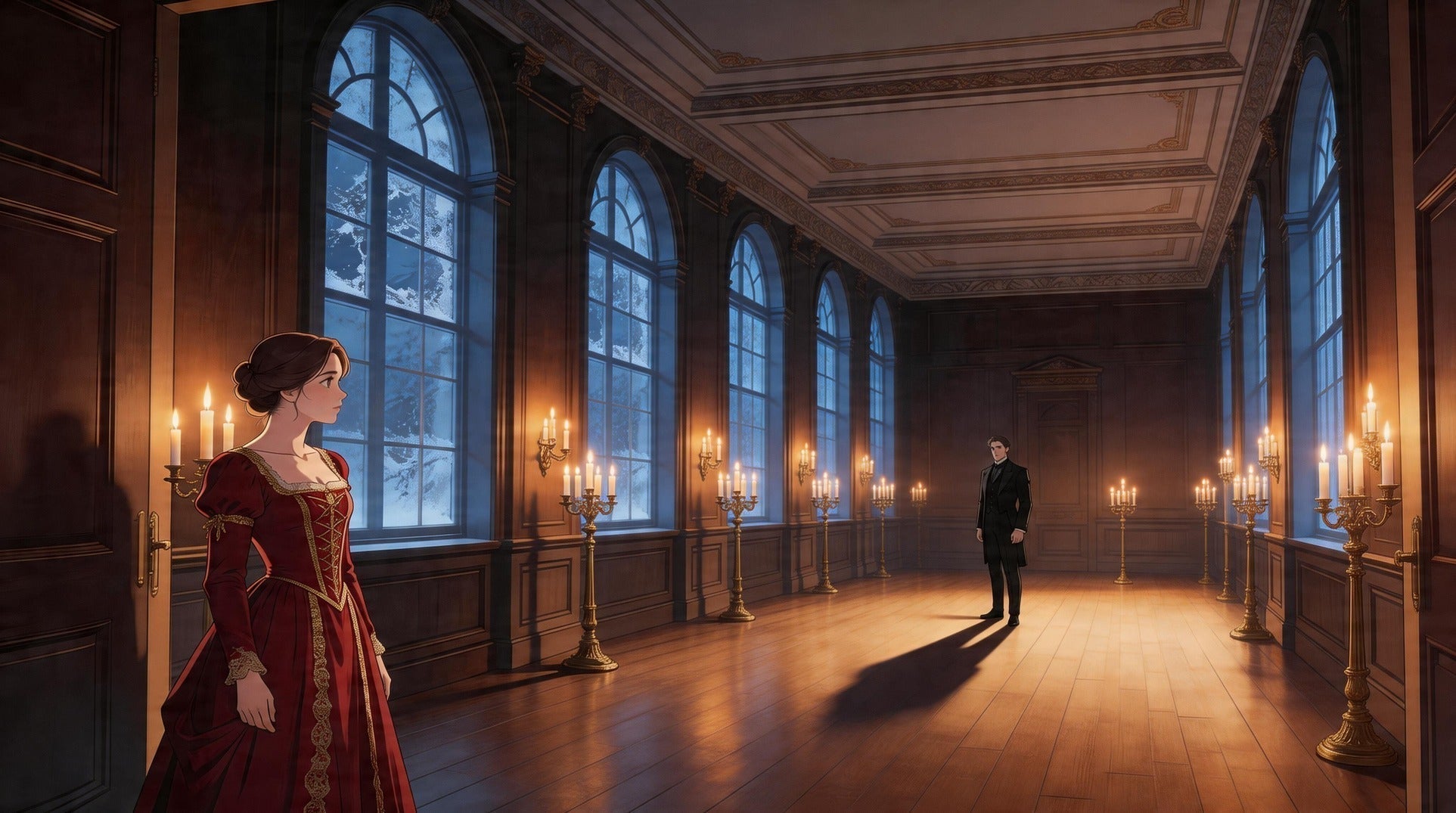
He stood at the end of the hall.
Lord Adrian Vane wore black like a second skin, and the candlelight broke in his hair like smoke that didn’t know where to rise. He was taller than she expected. Thinner. His features had something sculpted about them, as if someone had tried to carve beauty from stone but stopped halfway – frightened by what they had created.
And his eyes.
They were grey. Not the soft grey of doves or morning mist, but the grey of gun barrels. Of things you’d rather not look at for too long.
“Miss Ashworth.” His voice was deeper than she expected. Rougher. As if he used words reluctantly, deeming each one a waste.
“Lord Vane.” She curtsied, as was proper, but her knees felt alien, as if they belonged to someone else. “I thank you for your… hospitality.”
The word hung between them, heavy and false.
He did not reply. Instead, he scrutinised her with the kind of attention that reminded her of insect collectors – precise, detached, as if cataloguing her for a collection no one would ever see.
“You are smaller than I thought,” he said finally.
Eleanora blinked. “That is possibly the strangest thing anyone has ever said to me as a greeting.”
“I rarely say things by way of greeting.” He turned away, as if the conversation was already over. “Mrs. Thornton will show you to your room. Dinner is at eight. I do not expect conversation.”
And with that, he was gone, his steps on the marble as soft as the promise of snow.
Eleanora stood still, the taste of something bitter on her tongue.
He hated her.
That was obvious. Not the kind of hatred that erupted in loud words and broken things, but the other kind – the cold, the silent kind, that felt like a room no one ever entered.
She took a deep breath.
Twelve months. She had twelve months to convince a man who looked as though he had forgotten that people could be convinced. Twelve months to get a yes from someone whose entire body seemed to be one prolonged no.
At least, she thought, as Mrs. Thornton led her through endless corridors, it wasn't boring.
In the first week, Eleanora learned the geography of the house – its hidden nooks and locked doors. She learned that Lord Vane lived in the library as other people lived in their bedrooms, that he read books as if they were oxygen, and that he looked at her when she entered a room, only to immediately look away again, as if the sight had burned him.
She also learned that he did not appear for dinner.
Not on the first evening. Not on the second. Not on the five evenings after that.
On the eighth day, she had had enough.
“Pardon the intrusion,” she said, opening the library door without knocking. The lie felt sweet on her tongue.
He sat in an armchair by the fire, a book on his lap, and his head snapped up like that of an animal scenting danger. For a moment – just one – she saw something flicker in his eyes. Surprise. Perhaps even something vaguely resembling interest.
Then it was gone.
“I did not ask for company,” he said.
“And I did not ask for an engagement I didn’t want.” She stepped inside, closing the door behind her. “It seems we both get things we didn’t order.”
Silence.
The fire crackled. Outside, it began to rain, and the drops on the windows sounded like fingertips begging for entry.
“What do you want, Miss Ashworth?” His voice was so even, so controlled, that it sounded almost mechanical. Almost. But there was a crack, somewhere beneath the surface – a tremor she felt more than heard.
“To understand,” she said. “Why do you hate me?”
He set the book aside. The movement was slow, precise, as if he calculated every muscle. “I do not hate you.”
“You avoid me like a disease.”
“That is not dislike.” He stood up, and only then did she realise how tall he truly was, how his shadow stretched across the floor. “It is caution.”
“Caution.” She tasted the word, found it bitter. “Of what?”
He came closer. One step. Two. Then he stopped, so near that she could smell him – ink and old paper and beneath that something darker that tasted like smoke.
“Of myself,” he said softly.
Eleanora swallowed. Her throat felt tight, and her heart beat too fast. “That’s not an answer.”
“It is the only one I have.”
His eyes held hers, and for the first time she saw something other than coldness in them. There was hunger. Dark and deep and so carefully hidden that she almost hadn’t recognized it.
But she did.
Because she felt the same.
She stepped back. Once. The distance felt like a defeat.
“Good night, Lord Vane,” she said, and her voice sounded foreign in her own ears. “I expect you for dinner tomorrow.”
She left the library before he could reply.
He came.
The next evening, precisely at eight, he appeared in the dining room. He sat opposite her, the length of the table between them like a battlefield, and he ate without looking at her, spoke fewer than twenty words, and left the room as soon as his plate was empty.
But he came.
And the evening after. And the evening after.
It became a ritual. A war waged in silence. She asked; he answered in fragments. She spoke of London, of the balls she had hated, of the books she had loved; he listened with that expression that revealed nothing and concealed everything.
Slowly, like ice melting in spring, the answers grew longer.
“You read Latin?” he asked one evening, when she mentioned she preferred Ovid in the original.
“My father insisted.” She twirled the wineglass in her hand, watching the candlelight break in the red. “He said a woman who cannot think is like a bird without wings.”
Something flitted across his face. Too quick to grasp. “Your father was an unusual man.”
“He was a tyrant.” The words came out before she could stop them. “But a brilliant one. The most dangerous kind.”
Silence.
Then: “Why did you agree? To come, I mean.”
She looked at him. Truly looked. The sharp angles of his face, the shadows under his eyes that revealed he did not sleep, the mouth that looked as though it had forgotten how to smile.
“Because I had no choice,” she said. “And you?”
He put down his cutlery. The fork clicked against the porcelain like a period at the end of a sentence.
“Because my father wanted it,” he said. “Before he died.”
“And you always do what your father wanted?”
“No.” His voice was so soft she had to lean forward. “Only the things he should never have asked for.”
The candles flickered. Outside, the wind moaned, and Eleanora felt something stir in her chest – something she had long thought dead.
“What happened to you?” she asked.
He stood up. Abruptly. His napkin fell to the floor, but he did not stoop to pick it up.
“Good night, Miss Ashworth.”
He left. Again.
But this time he turned at the door, and his gaze brushed her like fingertips over sensitive skin.
“Don’t ask,” he said. “You wouldn’t want the answer.”
She asked. Of course, she asked.
Not him. The house.
Mrs. Thornton told her fragments, grudgingly, like someone giving pearls from a closed fist. Lord Adrian’s mother, deceased at his birth. His father, a man who confused love with control. A childhood of duty, of expectations, of the constant awareness of not being enough.
And then – the fire.
Three years ago. A fire in the east wing that no one could explain. Lord Adrian had gone in to save someone and returned with scars no one saw.
Except those he carried on his left side, hidden beneath waistcoats and high-collared shirts.
Eleanora lay awake at night, thinking of fire. Of scars. Of men who hated themselves for surviving when others did not.
She understood more than she should have.
Winter crept on.
Their dinner conversations grew longer, more complicated. They argued about philosophy, about politics, about whether Byron was a genius or a charlatan. He had opinions – sharp, unexpected opinions that sparked out of him when she provoked him.
And she provoked him. Again and again.
Because then he came alive. Because his eyes stopped looking like dead things and instead burned.
“You are impossible,” he said one evening, but his voice sounded different. Softer.
“And you are a coward,” she retorted.
He flinched. Actually, physically flinched, as if she had struck him.
“Yes,” he said then, and the word tasted like blood. “I am.”
She stood up. Walked around the table. Her heart pounded so loudly she was sure he must hear it.
“Look at me,” she said.
He did. Slowly. Reluctantly. His eyes met hers, and there was that hunger again, so naked it stole her breath.
“You are not a coward,” she said. “You have just forgotten what courage means.”
His hand moved. Lifted. For an endless moment she thought he would touch her – her cheek, her hair – but then he let it fall again.
“Go,” he said. “Please.”
The please was the worst part.
She went.
Christmas came and went in a silence that tasted of unspoken things.
Eleanora found a parcel outside her door on the morning of December 25th. A book – Ovid’s Metamorphoses, a first edition, the binding so old and beautiful she wanted to weep.
No card. No explanation.
But when she looked at him at dinner, there was something in his face that looked like hope, ashamed to exist.
“Thank you,” she said softly.
He nodded. His fingers tightened around his wineglass.
“Transformations,” he said. “It seemed… appropriate.”
She understood.
January brought a snowstorm that cut the house off from the world for three days.
On the second day, she found him in the library, the fire almost out, an empty glass in his hand. He looked up as she entered, and this time he did not look away.
“You should be sleeping,” she said.
“I don’t sleep.” The words came out rough, honest. “Not anymore. Not since…”
He trailed off.
She sat next to him. Not opposite. Next to him, so close that their sleeves almost touched.
“Tell me about the fire,” she said.
Silence. Long. Breathless.
Then he began to speak.
He told her of the night he woke to the smell of smoke. Of the screams. Of the maid he carried out as the ceiling collapsed above him. Of the heat that devoured his skin, and the darkness that followed.
“I wanted to die,” he said. “Afterward. Weeks, months. I no longer wanted to exist in a body that looked like a map of my failures.”
Eleanora’s eyes burned. “It wasn’t your fault.”
“That is irrelevant.” He looked at her, his gaze so open, so wounded, it hurt. “Guilt has nothing to do with logic. It lives in the bones. In the skin. It becomes part of you, like scar tissue.”
She understood that. More than he knew.
“Show them to me,” she said.
He stiffened.
“The scars,” she continued. “I want to see them.”
“Why?” The word was like a stone, heavy and dangerous.
“Because you hide behind them.” She raised her hand, placed it on his arm. Through the fabric of his shirt, she felt his pulse, too fast, too wild. “And I’m tired of talking to a man who isn’t there.”
He swallowed. His throat moved.
Then he began to loosen his tie.
Eleanora did not breathe as he unbuttoned his shirt. One by one. The air between them had grown thick, electric.
He pulled the fabric aside.
The scars began on his shoulder and ran across his left chest, his collarbone, down to his ribs. The tissue was uneven, thickened, lighter than the rest of his skin – a map of pain.
Eleanora reached out her hand.
He intercepted it. His grip was firm, but not painful. His breath came in short gasps.
“Don’t,” he said.
“Why?”
“Because I don’t know what I’ll do if you touch me.”
The words hung in the air, heavy as lead, sweet as poison.
She did not pull her hand back. Instead, she rotated her wrist in his grip until her fingers intertwined with his.
“Then let’s find out,” she said.
He closed his eyes. A sound escaped him – half groan, half something fragile.
Then he pulled her to him.
The kiss was not gentle.
It was hungry, desperate, all the unspoken things finally finding a language. His hands dug into her hair, dislodging the pins, and she heard them fall to the floor like raindrops.
“Eleanora,” he murmured against her lips, and the sound of her name in his voice – for the first time – felt like a confession.
“Adrian.” She pressed closer, feeling the heat emanating from him. “I want –”
“Do you know what you want?” He pulled back, just enough to look at her. His eyes had darkened, his pupils so dilated they swallowed the grey. “Do you know what you’re getting into?”
“Yes.”
He paused. His thumbs stroked her cheeks, so tenderly it hurt.
“I’m not good,” he said. “Not for you. Not for anyone.”
“Then be bad.” She reached for him, pulled him closer again. “Be everything you need to be. But stop shutting me out.”
Something broke in him. She saw it – the moment his control shattered like thin ice.
He kissed her again. Deeper. Slower. His hands slid over her back, finding the lacing of her dress.
They fell onto the rug in front of the fireplace.
He paused, above her, his breath heavy.
“Are you sure?” he asked.
“Yes.” The word was all she had.
He nodded. Once. Then he lowered himself to her.
It was not gentle.
Nor was it brutal. It was something in between – something nameless, that felt like falling and flying at the same time. His scars pressed against her skin, and she felt them, every single one, a story he wrote into her body.
“Look at me,” she said, as she felt his control crumble.
He opened his eyes.
In that moment, she saw everything. The pain. The fear. The hope he had buried for so long.
“I see you,” she said.
And he broke.
Afterward, they lay still, entwined, the fire a gentle flicker beside them.
His fingers traced patterns on her shoulder. Circles. Spirals.
“I’m scared,” he said softly.
“Of what?”
“That I’ll ruin this. That I’ll ruin you.”
Eleanora smiled. It was the first genuine smile in weeks.
“Then ruin me,” she said. “I’ll do the same.”
He laughed. A short, surprised sound, as if he had forgotten he could.
“You are impossible,” he said.
“You’ve said that before.”
“I know.” He pulled her closer. “I meant it then, too.”
The snow continued to fall outside, blanketing the world in white.
But here, in this room, it was warm.
Three months later, they married.
Not because the will demanded it. Not because society expected it. But because they wanted it – both of them, together, in a decision that felt like the first free choice they had ever made.
The wedding was small. Quiet. Spring was just arriving at Blackmoor, and the first buds were breaking through the still half-frozen ground.
As he slipped the ring onto her finger, his hands trembled.
As she said “I do,” his voice cracked.
And as he kissed her, before the altar, she tasted salt on his lips.
“You’re crying,” she whispered.
“I know.” He smiled, and it was the most beautiful, most fragile thing she had ever seen. “I had forgotten how.”
The months passed.
They argued. Of course they argued – about books, about politics, about whether the fire in the library was too hot or too cold. They argued loudly and passionately and made up in ways that left them both breathless.
But they never argued about what was important.
Because what was important was settled.
"You saved me," he said one evening, as they stood on the balcony, watching summer creep across the fields.
She shook her head. "I held a mirror up to you. You did the rest yourself."
He thought about it. For a long time.
"No," he said finally. "The mirror was the most important thing."
And in a way, he was right.
Sometimes, at night, when the nightmares came, he would wake up screaming.
Then she would hold him. For hours, if necessary. She said nothing, asked nothing, was simply there – an anchor he could cling to until the darkness receded.
And sometimes, when her own demons haunted her – the memory of a father who confused love with control, of a childhood where obedience was the only alphabet – then he would hold her.
They didn't heal each other.
That was impossible. That wasn't how healing worked.
But they learned to live with the fractures.
Together.
A year after the wedding, Eleanora stood at the library window, looking out at the snow.
It was December again. A year. A whole year.
Adrian came up behind her, put his arms around her, pulled her close.
"What are you thinking about?" he asked.
"The day I arrived." She leaned back against him, felt his heartbeat against her back, steady and calm. "You said you didn't expect conversation."
He laughed softly. His breath was warm against her ear. "I was an idiot."
"Yes." She turned around, looked at him. "You were."
He kissed her. Gently. Slowly. As if they had all the time in the world.
And perhaps they did.
"I love you," he said when they separated. The words still came hard to his lips, as if each one cost him something.
"I know." She smiled. "I love you too."
The fire crackled. The snow fell. The world outside was cold and still and beautiful.
But here, in this room, in these arms, she was home.
Finally.