On the same side of the web

The most dangerous opponent was never the one on the other side of the net.
Serena Vance felt the serve in her shoulder before she hit it – that vibration between bone and sinew that told her the ball would land exactly where she wanted it. The yellow felt left her fingers, rising into the evening sun over Indian Wells, and for a heartbeat it hung motionless in the air, a dot of gold against the sky bleeding magenta and violet. Then the strike. Clean, flat, devastating. The ball whistled over the net and landed on the line, just close enough to make a linesman sweat.
But the other side of the court was empty.
Serena stood alone on the court. Eight-thirty in the evening, the stands ghostly, the floodlights not yet on. Only the humming cyan of the halogen lamps on the maintenance buildings cast their light over the asphalt beyond the facility, where the Californian evening lay damp and heavy on the parking lots. She hit another serve. Another. Each one hard enough to silence something deeper than technique.
Tomorrow the Pacific Coast Invitational would begin. The tournament she hadn't won in three years. Not since he had appeared.
Rafael Cruz.
Saying his name felt like walking barefoot on hot concrete – inevitably painful if you lived in Southern California. He was everywhere. On the covers of Tennis Magazine, on billboards along Highway 111, on the lips of every commentator describing their rivalry as the best thing to happen to the mixed doubles circuit of the eighties. The press called them forbidden attraction with baseline strokes, as if their story were a soap opera and not a war.
Serena collected the balls, one by one, her fingers in the yellow felt that smelled of rubber and dust. The air tasted of chlorine from the nearby hotel pool and something metallic that might have been the approaching rain. She squeezed three balls in her left hand – a ritual her father had taught her before he stopped teaching anything – and turned to the exit.
He was leaning against the gatepost.
Of course, he was.
Rafael Cruz wore a black polo shirt that strained at the shoulders as if the fabric had surrendered, and white track pants that almost glowed in the halogen light. His dark hair was longer than when they last met in Melbourne, falling onto his forehead, and his eyes – those eyes the color of freshly brewed espresso and burning just as hot – rested on her like a second serve he was trying to read.
“You're early," he said. His voice was deeper than the hum of the halogen lamps.
“You're in the way." Serena walked on, aiming for the ten feet of space between his elbow and the fence. But he straightened up, and suddenly that space no longer existed.
“We need to talk about tomorrow."
“No."
“Serena."
His mouth formed her name as if savoring it, and she hated how the syllables sounded when he spoke them. Softer. More dangerous. As if he were filing down the sharp edges she had so carefully honed.
“Mixed doubles isn't until Saturday," she said, stopping a step in front of him, close enough to smell his aftershave – cedarwood and something bitter she could never identify, but which clung to her memory like resin to a racket grip. “Until then, we have nothing to discuss."
“The tournament organizers changed the seeding." He pulled a folded paper from his pocket. “You and I. First mixed doubles match. Together."
The words took a moment to penetrate the layer of exhaustion, sweat, and strict discipline Serena had built between herself and the rest of the world. Then she understood.
“That's a joke."
“The tournament director has a remarkably poor sense of humor." Rafael held out the paper to her. She didn't take it.
“I'm not playing with you."
“You don't like playing against me. That's a difference."
“There's no difference. You're unbearable on both sides of the net."
He smiled. It wasn't a friendly smile. It was the smile he put on before hitting a return that not only defeated his opponents but humiliated them – controlled, precise, and with a warmth in his eyes that was completely at odds with the coldness of the shot.
“Seven A.M. tomorrow," he said. “Practice court four. We should at least pretend to get along."
He left. Serena watched his silhouette cut into the magenta of the evening sky, dark and definite, and she noticed that her hand, which hadn't taken the paper, was still hanging in the air.
She clenched it into a fist.

The rain came around three in the morning. Serena lay awake in her hotel room, listening to it beat against the window – rhythmic, insistent, as if someone were tapping their fingers, asking for entry. The room smelled of the air conditioning, set too cold, and the body lotion she had used since she was sixteen and her first sponsor paid for it. Coconut and vanilla. The smell of control and routine.
She thought of Melbourne. Of the semifinal eighteen months ago when she had faced Rafael in mixed doubles – on opposite sides, as it should be – and he had passed close enough during a changeover in the third set for his arm to brush hers. A touch that might have been accidental, and perhaps not, and that had felt like a short circuit under her skin. She had netted the next serve. Her only double fault of the tournament.
After the match, he had said in the press conference, “Serena Vance is the best player I've ever seen. And the toughest opponent I've ever had." The journalists had dug for subtext. He had just smiled. That smile.
She rolled onto her side and stared at the neon sign of the hotel across the street, flickering through the rain – turquoise and pink, the letters blurred into a smear of color. The bed was too soft. Everything here was too soft. California, with its palm trees and its sunsets and its refusal to ever truly get cold. She missed the harshness of winter in Connecticut, where she grew up. There, the cold had a reason. Here, even pain was lukewarm.
At quarter to seven, she was on practice court four. The air was damp from the night rain, the asphalt dark, and the white lines glowed like scars on wet skin. She wore her high-necked warm-up shirt and hit forehands against the wall when he arrived.
On time. Of course.
She practiced in silence. That was the worst thing about Rafael Cruz – that silence with him wasn't silent. It hummed. It had a frequency she felt in her teeth. Every ball they played was a sentence neither of them spoke. His backhand – smooth, fast, with a rotation that made the ball bounce so late that it was already past before the eye registered it – said things his mouth never articulated.
After an hour, he paused. Sweaty, black hair clinging to his temples, his chest rising and falling beneath his white shirt. He leaned on his racket and looked at her.
“You're playing too far back."
“I play where I play."
“In doubles, you have to come forward. To the net. To me."
“I prefer playing from the baseline."
“I know. But tomorrow you're playing with me, not against me. And that means you have to trust me."
The word hung between them like a lob hit too short – in the air, undecided, and they both knew it would land on the wrong side.

“Trust," she repeated, making it sound like a diagnosis.
“You say it as if it's a disease."
“Maybe it is."
He stepped closer. Three steps. Two. The distance where you feel a volleyer before you see the ball. The distance where his breath reached hers.
“What do you have against me, Serena?"
It was the first time he had asked directly. Not in an interview. Not through a third party. Here, on wet asphalt, with raindrops falling from the overhang and hitting between them like stray serves.
“Everything," she said.
And she meant it. Everything about him was a problem. His presence on the court, so dense that it disrupted her own rhythm. The way he looked at her, as if seeing through every layer she had piled between herself and the world. His hands, large and calm, holding a racket as if it were an extension of his nervous system. His voice, echoing in her head at night, even when he hadn't said anything meaningful.
He was the opposite of control. And control was all she had.
They won their first match on Saturday in two sets. It was brutal and beautiful and made her angrier than a loss.
Because it worked.
His game complemented hers with a precision that frightened her. When she retreated, he advanced. When she opened the angle, he closed it. They didn't communicate – no hand signal, no glance – yet he read her movements as if they were written in a language only he understood. In the second set, on break point, she played a cross-court forehand that was too risky, and he was already at the net before the ball reached the opponent's baseline, volleying it into the corner as if he had seen the shot in her shoulders before she herself felt it.
They didn't shout. They didn't raise their fists. They looked at each other, ten feet apart, and the air between them was so charged that Serena swore she could taste it – metallic and warm, like last night's rain on hot concrete.
That evening, she found him in the hotel bar. He sat alone at a table near the window, where the wet palm trees swayed in the wind and the neon light of the cocktail signs cast magenta and cyan hues on his features. In front of him was a glass of bourbon he hadn't touched.
She sat down without asking.
“You read my return in the second set," she said. No greeting. No introduction. “How?"
He turned the glass between his fingers. The liquid caught the light, amber and still.
“Your left shoulder."
“What about it?"
“It drops two centimeters before you hit cross-court. Not down the line. Only cross."
The information hit her like a passing shot she hadn't seen coming. Not because it was true – she couldn't verify it – but because he had it. Because he had looked closely enough, long enough, attentively enough, to notice a two-centimeter difference in her shoulder posture. That wasn't analysis. That was obsession.
“How long have you known?"
“Since Wimbledon. Two years ago."
Two years. He had been reading her body for two years, and she hadn't noticed. Or had she. Perhaps that was precisely why she couldn't breathe next to him – because a part of her had always known he was watching, and another part wanted him never to stop.
“That's –" She broke off.
“What?"
“Too much."
He looked up. In the bar's neon light, his eyes were not espresso brown, but almost black, with a rim of gold burning where the turquoise of the sign touched them.
“Too much of what?"
She didn't answer. Instead, she took his glass and drank. The bourbon burned in her throat, smoky and warm, and she tasted the remnants of his lip print on the rim – an intimacy so small and so enormous that her stomach clenched.
He watched her. Not her mouth. Her eyes.
“You don't hate me," he said softly.
“No."
“Then what?"
Silence. The rain tapped against the window. A jukebox in the corner played something by Fleetwood Mac – Stevie Nicks' voice, raw and yearning, and the synthesizers hummed like a memory of something that hadn't happened yet.
“I hate that you see me," Serena said. “Nobody sees me. Not like that."
The confession hung between them like a ball at the peak of its flight – weightless and inevitable all at once. He leaned forward, slow enough that she could have retreated. Didn't. His hand covered hers, which clutched the glass. His thumb stroked her knuckle, once, and the touch was so precise and so gentle that she understood: He wasn't playing. Not here. Not now.
“Come with me," he said.
Not a question. Not a command. A possibility he placed in the room and left for her.
She took it.
His room was on the third floor, and the window overlooked the parking lot, where puddles reflected the neon light – cyan and magenta on black asphalt, like a city submerged. He closed the door, and the sounds of the world fell away like extinguished headlights, and suddenly there was only his breath and hers and the rain and the pounding in her temples that had nothing to do with tennis.
They stood facing each other. Two steps apart. The distance of a net attack.
“Tell me to stop," he murmured. “And I'll stop."
She looked at him. The wet strand at his temple. The shadow of his cheekbones in the subdued light. The way his chest rose – controlled, but not calm, and she knew that rhythm, knew it from the moments on the court when he gathered himself before giving his all.
“Don't stop," she said.
He stepped forward. His hands found her waist, and the warmth of his palms permeated the thin fabric of her dress as if he were touching her directly on the skin. She placed her hands on his chest. Beneath the shirt, she felt his heartbeat – faster than expected, and that was it, that one detail that broke her last resistance: that this man, who used control like a weapon on the court, trembled under her hands.
His mouth found hers, and the kiss was not a beginning. It was a continuation. As if they had done this a thousand times, in every glance, every changeover, every intentionally ignored touch, and as if this moment were just the point where everything finally became loud.
He kissed her slowly. Thoroughly. With an attention that undressed her long before his fingers did. His tongue grazed her lower lip, and she opened, and the taste of him – bourbon and rain and something dark, distinct – filled her mouth, and for the first time in years, she forgot to think strategically.
His hand slid up from her waist, over the curve of her ribs, slow enough that every inch was a question she answered with the arch of her back. He unzipped her dress – a sound like a soft breath – and the fabric fell from her shoulders, and the cool air of the room hit her bare skin like a change of ends that changed everything.
“Serena." He spoke her name against the hollow of her neck, and his breath was hot and irregular, and she felt his lips, his teeth, the tip of his tongue on the sensitive spot below her ear, and a sound escaped her throat that she hadn't planned – raw, unfiltered, honest.
She pulled his shirt over his head. Her hands glided over his shoulders, the muscles she knew from a distance, which now felt like a landscape under her fingers – warm, alive, scarred by years of using his body as an instrument. Here a scar on his collarbone – surgical scar, she had read about it, shoulder, three years ago. There the hard line of his abs, tensing as her fingers glided over them, and a breath he drew in between his teeth that said more than any press conference he had ever given.
They fell onto the bed. Not elegantly. Not like in the movies that played after midnight on hotel television. His knee hit the mattress first, and he pulled her with him, and she laughed – softly, surprised, a sound she no longer recognized – and his face above hers was so close that she could count the individual eyelashes and the tiny mole under his left eye that was not visible in any photo.
“What?" he asked.
“Nothing."
“You never laugh."
“I do laugh."
“Not like that."
He was right. This wasn't a laugh she controlled. It had escaped her like a return anticipated too late – past her before she could prevent it.
His lips found the hollow between her collarbones, and he kissed her there, slowly, with an open mouth, and his hand lay flat on her stomach, and the warmth spread like something that had been under pressure for too long and finally gave way. He took his time. Unbearable, deliberate, attentive time. Each touch a sentence he wrote on her skin, and she read it with closed eyes and open mouth and the feeling that every layer she had built in twenty years melted under his hands like wax.
And then there was no more fabric and no more distance and no net between them, only skin on skin and his weight over her and her legs around him and the sound she made when he moved – soft and broken and so far from control that it felt like flying and falling at the same time.
Afterwards, he lay beside her, on his back, arm over his eyes. His chest rose and fell. The rain had stopped, and the neon light outside cast a still pattern on the ceiling – lines of turquoise and pink that moved when the wind shook the palm trees.
Serena lay on her side, watching him. The line of his profile. The place where his neck met his shoulder. Her hand lay on the mattress between them, a finger's width from his, and she did not bridge the distance.
“Say something," he said.
“What should I say?"
“Whatever you're thinking."
“I think this was a mistake."
He took his arm from his eyes. Turned his head. In the dim light, his face was calm, but she saw the muscle in his jaw work – once, twice – and she knew that twitch. It was the same one she saw when he was at 30:40 and deciding whether to play it safe or take a risk.
“Why?"
“Because tomorrow we're back on the court. Because the entire tennis world is watching. Because I don't want to be the player who sleeps with her mixed doubles partner and then loses focus."
“And if you don't lose focus?"
“Then I lose something else."
He understood. She saw it in the way he pressed his lips together and turned his gaze back to the ceiling. He understood that it wasn't about him. That it was about what she had to give up to let him in – the walls, the discipline, the carefully constructed system of routines and rituals and strict solitude that had made her the player she was.
“Okay," he said.
“Okay?"
“I'm not going to force you to like this."
He got up. Pulled on his pants. His back was to her, and she watched the line of his spine, the shadows in the hollows beside his shoulder blades, and something in her chest tightened – a muscle she didn't know, in a place no training reached.
“Rafael."
He half-turned.
“It wasn't a mistake," she said, her voice softer than intended. “But it scares me."
He nodded. Once. Then he went into the bathroom, and she heard the water running, and she lay alone in a bed that smelled of him – cedarwood and bourbon and skin – and she pressed her face into his pillow and breathed in and hated herself for it and did it anyway.
Sunday. Second round.
The tournament knew no more rain. The sky over Indian Wells was flawless, a blue so aggressively bright that it almost felt intrusive, and the sun hammered down on the hard court as if it had something to prove. The stands were full. Eight thousand people, sunglasses and baseball caps and the smell of sunscreen and overpriced beer.
Serena and Rafael entered the court through separate entrances. They wore the same team colors – white and navy blue, the tournament management had decided – and Serena hated how good he looked next to her, how natural the picture they made together seemed as the photographer raised his camera before the match.
She didn't smile. Neither did he.
They played against the Andersons from Texas – Sarah and Michael, solid players, good net play, predictable patterns. It should have been easy. It wasn't.
In the first set, Serena played as if there were a glass wall between her and the rest of the court. Every shot technically perfect, every decision correct, and yet – no flow. No instinct. She thought too much. Calculated angles instead of feeling them, and every time she felt his presence at the net, something in her chest tightened, and her shots became a millimeter inaccurate, and in tennis, a millimeter was the difference between genius and failure.
Changeover. 4:5. His towel. Her towel. The bench between them that felt like the Grand Canyon.
“You're thinking too much," he murmured, without looking at her. Drank from his bottle. Wiped his mouth.
“Shut up."
“Your forehand is three centimeters too low. Because you're controlling your swinging arm instead of letting it go."

“I said, shut up."
He put down the bottle. Looked straight ahead, at the court, where the Andersons quietly conferred and shook hands.
“Last night you weren't thinking," he said, so softly that only she heard it. “And it was the best thing I've ever experienced. On court and –" He broke off. “Play like that. Not against you. Not against me. With me."
She said nothing. But in the next game, she hit a forehand that came from the gut, not the head, and the ball landed on the line, and Rafael was at the net and volleyed the return into the open court, and suddenly the rhythm was there – brutal, instinctive, and so in sync that the commentator mumbled something about “telepathic communication" and the crowd stood up.
They took the set. Won the second 6:3.
At the net, during the handshake with the Andersons, Rafael's hand brushed her back. Not the shoulder pat mixed doubles partners exchanged. Deeper. At the spot where his thumb had traced her spine last night. A touch that lasted a second and contained an entire conversation.
She didn't look at him. But she didn't flinch.
Monday. The press smelled blood.
“Vance and Cruz – Chemistry on Court?" Tennis Weekly headlined. “The Rival and the Rival: What Happens When Enemies Become Partners?" The LA Times sports section featured a photo of them at a changeover, their knees almost touching, and the caption was so insinuating that Serena crumpled the paper and threw it into the trash can next to her breakfast table.
Her coach, Jim Harrigan – sixty years old, face like tanned leather, voice like sandpaper – sat opposite her and placed his hands on the table.
“What the hell are you doing?"
“I'm eating scrambled eggs."
“You know what I mean."
“We're playing a tournament. Mixed doubles. The tournament management forced me."
“I'm not talking about the tournament." He leaned forward. “I've spent thirty years in this sport. I know that look."
“What look?"
“The one you have on court when you're standing next to him. The same look you never had when you played against him. Then you were focused. Now you're –" He searched for the word.
“What?"
“Open."
The word hit her harder than any criticism of her technique. Open. That was the last thing she was allowed to be. Openness was a gap in the defense, an unforced error, an invitation sign for anyone who knew where to strike.
“It's a tournament, Jim. Nothing more."
He looked at her for a long time. Then he stood up. At the door, he turned.
“Your father always said it was nothing more, too. About everything that was important to him."
He left. And Serena sat alone with her scrambled eggs and the feeling that Jim Harrigan had just said the one thing she least wanted to hear.
Her father. David Vance. Former college tennis player who had sacrificed his career to an injury and planted his unfulfilled dreams in his daughter like seedlings in dry soil. He had coached her until she was fourteen. Had taught her that the court was the only place where emotions had no business. That control was not just a strategy, but a way of life. That you didn't need anyone.
Then he left her mother. And Serena learned that he had been right – not because he was wise, but because he was living proof that you couldn't trust people who told you emotions were weakness.
The irony burned like stomach acid.

Tuesday. Practice court. Alone.
She hit serves until her shoulder ached, and the pain felt good because it was familiar. Controllable. Her pain. Not his. She didn't count. Eventually, the ball basket was empty, and she stood on the court, breathing, and the air was hot and dry and tasted of nothing, and that was exactly what she needed.
Her phone buzzed. A message.
You're missed on court 4. – R
She stared at the screen, and the six words glowed like neon letters in the dark. You're missed. Not: Where are you? Not: We need to practice. You're missed.
She didn't reply. Deleted the message. Reopened it in the trash. Deleted it again. Closed the phone.
In the evening, when she entered the hotel gym, he was there. On the rowing machine, his shirt dark with sweat, his strokes steady and powerful, and she could have turned around. She could have gone back to her room, turned on the TV, watched the neon light of the hotel across the street, and pretended everything was under control.
Instead, she sat on the bike next to him and pedaled, and they trained side by side, silently, for thirty minutes. The only sounds were the whirring of the machines and their breathing, and the silence hummed again, had that frequency again that she felt in her teeth, and when her thirty minutes were up, she got off and said, without looking at him:
“Tomorrow. Court four. Seven o'clock."
She left before he could answer.
Wednesday. Quarter-finals.
Against the Brennans – he Australian, she British, both playing with the aggression of players who had nothing to lose. And it was the match where something happened that Serena couldn't plan for.
Second set, tie-break, 5:6. Rafael's serve. He tossed the ball, and Serena saw the swing, and she knew – the way you know things on the court, not with your head, but with your spine – that the serve would come up short. The Australian was ready. Return to her side. Hard, flat, body shot.
She reacted. Not strategically. Instinctively. Stepped forward, opened up the forehand, and in the millisecond her racket hit the ball, she felt the sting. Sharp, hot, in her left thigh. A muscle screaming.
She finished the point. Won it. And then she stood there, racket in hand, and the world tilted two degrees sideways.
Rafael was instantly by her side. Even before the umpire announced the break. Even before the physio ran from the side of the court.
“Where?" His voice was low, urgent.
“Thigh. Left. It's –"

“Sit down."
“It's nothing –"
“Serena. Sit down."
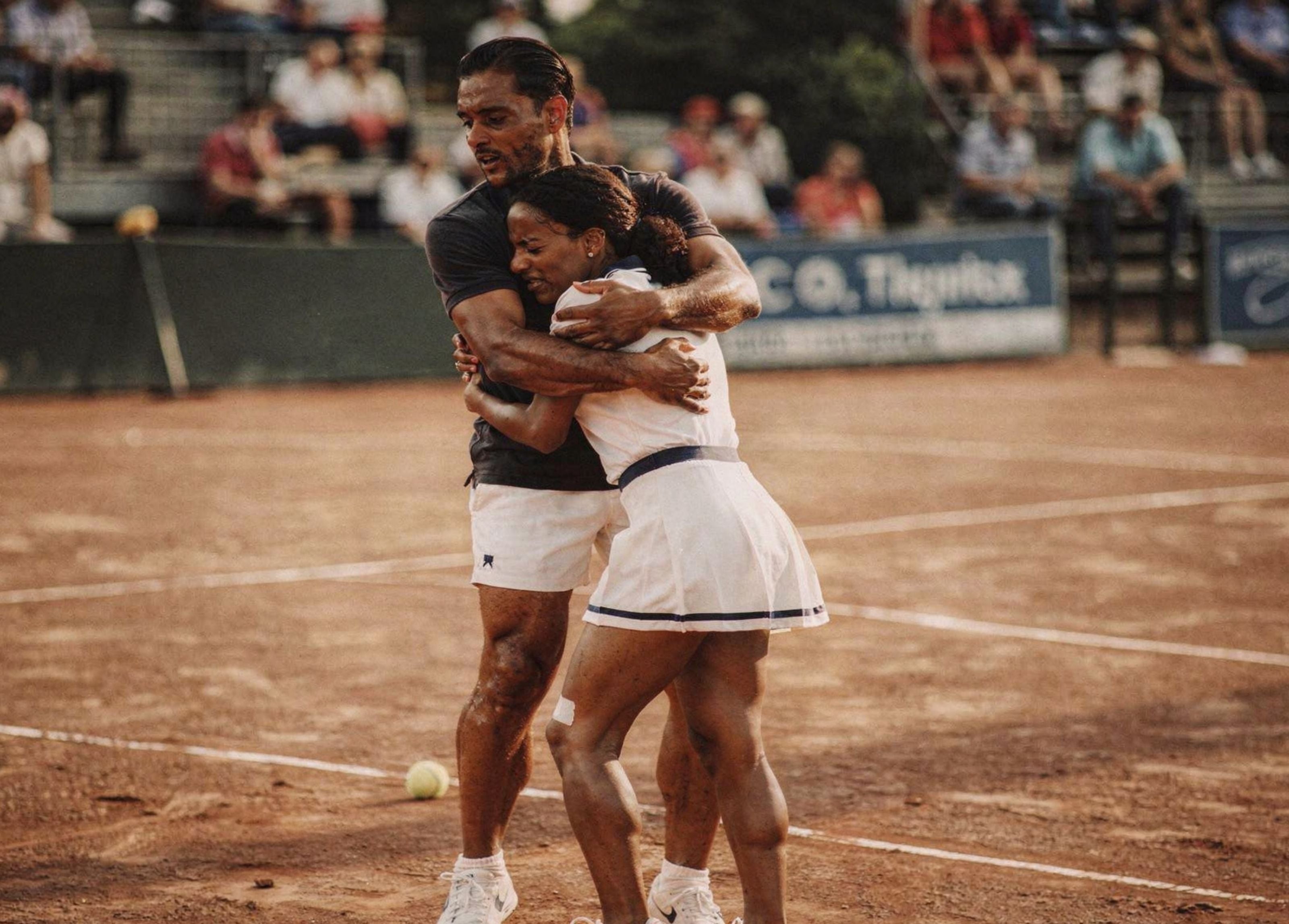
The way he said it. Not as a command. As something deeper, more honest, more naked. She sat down. The physio came, palpated, stretched, muttered something about a strain, no tear, ice, rest. The stands murmured. The camera zoomed.
And Rafael knelt beside her on the hot asphalt, one hand on her knee, and in his eyes was something she had never seen there before. Not worry. Not pity. Fear. Real, unfiltered, uncontrolled fear.
“I'm fine," she said.
“Don't lie to me."
“It's a strain, not an ACL tear."
“I'm not talking about your leg."
The words hung between them, in the middle of the court, before eight thousand people and three television cameras, and Serena looked into his face and understood that this man – this impossible, unbearable, unavoidable man – wasn't worried about the match. Not about the tournament. He was worried about her.
They played on. They won. Serena limped off the court after match point, and Rafael walked beside her, not touching, but close enough that his shadow overlapped hers, and the crowd applauded, and the cameras flashed, and she heard none of it.
In the players' tunnel, where the light was cold and neon white and the walls smelled of disinfectant, she stopped. He stopped beside her. She leaned against the wall, her weight on her right leg, and looked at him.

“Thank you," she said.
It was the first time she had thanked him. For anything. And the word felt foreign in her mouth, a language she was just beginning to learn.
He said nothing. Just placed his hand on the wall beside her head, and his arm formed an arch over her, and she stood in the space he created, and he smelled of sweat and sunscreen and cedarwood and the match they had won together, and she raised her hand and placed it on his cheek.
Rough. Warm. Real.
He closed his eyes. Turned his head into her touch, a millimeter, and his lips brushed her palm, and the gesture was so small and so devastating that something in Serena broke – not apart, but open. Like a door that had been locked for too long.
“Friday," she said. “Semifinals."
“Friday."
“We should practice."
“Tomorrow."
“Tomorrow."
He moved away from the wall. Walked down the tunnel, towards the changing room. Three steps. Five. Ten. She counted them, as she counted serves – automatically, like a heartbeat.
“Rafael."
He turned around.
“My left shoulder," she said. “Before the backhand down the line, it goes up. Three centimeters. Not two."
A smile. Not a predatory smile. Not a strategist's smile. A real one. It changed his entire face, made it younger, softer, and for the first time she saw the boy he must have been before the sport turned him into a weapon.
“I know," he said. “But I wanted to see if you knew."
He left. And Serena stood in the neon light of the tunnel and laughed. Softly. Uncontrolled. Honestly.
Thursday. Rest day.
The strain was mild enough that the physio cleared her, strict enough that Jim Harrigan forbade her from practicing. Serena spent the morning in an ice bath and the afternoon studying match footage of their semifinal opponents – the Petrovs, a brother-sister pairing from the Soviet Union who played with a brutality bordering on punishment.
At four o'clock, there was a knock on her room door.
She opened it. Rafael stood in the hallway, in jeans and a navy blue Henley that made his eyes darker, and in his hand he held a paper bag.
“What is that?"
“Food." He stepped in without waiting for an invitation, and she let him, because she was tired and because resisting Rafael Cruz took more energy than she had today. He placed the bag on the desk and pulled out styrofoam containers. The smell of grilled meat and roasted garlic filled the room.
“Carne asada," he said. “From the shop on 111. My mother says meat cures everything."
“Your mother doesn't know me."
“She saw your semifinal in Melbourne. She says you have the eyes of a warrior."
Serena opened the container. The meat was perfect – dark crusts on the edges, pink inside, with black beans and a salsa that smelled of lime and cilantro. She ate. He ate. They sat at the desk and on the bed and shared a meal as if it were the simplest thing in the world, and the window was open, and the evening wind carried in the scent of jasmine, and Serena thought: This is it. This is the danger. Not the sex. Not the touches. The normalcy. The possibility that this could be everyday life.
“Tell me about your father," he said.
She paused. Fork in mid-air. His gaze was calm, waiting, without pressure.
“Why?"
“Because every time someone talks about trust, you look like someone remembering a burn."
The precision of his observation hit her like one of his backhands – late, fast, and in a place she hadn't protected.
“He was my first coach," she said. Slowly. The words came one by one, like balls from a machine whose speed she didn't control. “He taught me everything I know about tennis. And then he left us. My mother. Me. Without explanation. Without farewell. One morning he just wasn't there anymore."
Silence.
“I was fourteen," she said. “And I learned that people who teach you how to be strong aren't necessarily strong enough to stay."
He put down his fork. Stood up. Sat beside her on the bed, close enough that their knees touched, and no closer.
“I'm not your father," he said.
“I know that."
“Do you know it? Or are you saying it?"
She looked at him. There was no pity in his eyes. No therapeutic gentleness. There was something harder, more honest – the directness of a player who knows that politeness has no place on a crucial point.
“I'm saying it," she admitted. “The knowing comes slower."
He nodded. He didn't put his arm around her. Didn't take her hand. Just sat there, his warmth beside hers, and let the silence hum, and this time it hummed differently. Not like tension. Like calm.
Eventually, she leaned her head against his shoulder. He didn't move. She closed her eyes.
“Tomorrow we play the Petrovs," she said.
“Yes."
“They'll aim for my backhand. Because of the leg."
“I know. That's why I'll be on the left."
“You're always on the left."
“Because you're always on the right. Even when you shouldn't be."
She smiled. Against his sleeve. And his arm lifted, slowly, and wrapped around her shoulder, and she allowed it, and the jasmine wafted through the open window, and for five minutes, the world was nothing but that.

Friday. Semifinals.
The Petrovs were everything the footage promised, and more. Nadia Petrova – tall, blonde, with forearms like steel cables – hit a forehand that physically hurt if you had to block it. Her brother Alexei played at the net with the patience of a spider and the reflexes of a cat.
First set: Petrov/Petrova. 6:4. Brutal.
At the changeover, Rafael said not a word. But he held out her water bottle, the cap already open, and as she drank, he said softly: “Second set. I'm switching to Australian formation. You serve to Nadia's backhand."
It was a risk. Australian formation – both players on the same side of the court before the serve – was a tactic that demanded perfect timing and absolute trust that your partner would cover the space you left behind.
“That's crazy," Serena said.
“You play your best tennis when it's crazy."
“That's not an analysis. That's a compliment."
“Both."
Second set. Serena served, and Rafael stood where he shouldn't, and the Petrovs hesitated – half a second of confusion that was an eternity in tennis – and Rafael volleyed the return into the open court before Alexei had oriented himself. And then again. And again.
They broke the Petrovs' serve in the seventh game. In the eighth, Serena hit an ace down the T, measured at 178 km/h by the radar, and Rafael turned to her and his eyes said something no commentator in the world could have translated.
Second set: Vance/Cruz. 6:3.
Third set. The court was a war zone. The sun burned, sweat ran, and every point was its own drama. At 5:5, Nadia hit a forehand that flew like a bullet to Serena's injured side, and Serena felt the sting in her thigh and knew she wouldn't reach the ball, and then there was a shadow beside her – Rafael, who had the ball, who stood in front of her, who had taken the return that wasn't his, because he knew her body better than she knew it herself.
The ball landed in the net. His ball. His error. He had taken the risk and lost.
He turned to her. Sweat on his forehead. Breath heaving.
“Sorry," he said.
And she looked at him, this man who would rather sacrifice his own point than watch her get hurt, and something in her finally broke open – not like a door this time, but like a dam, and everything that had been dammed up behind it flowed through her, warm and overwhelming and unstoppable.
“Not sorry," she said. “Never sorry."

They won the tie-break. 7:5. When the last ball landed – Rafael's volley, precisely on the line, the lineswoman nodding with closed eyes – Serena was at the net and he was behind her, and she turned, and he was there, and she put her arms around him.
In front of eight thousand people. In front of three television cameras. In front of Jim Harrigan, who stood at the edge of the court, shaking his head and smiling for the first time in thirty years in tennis.
She held him tight. Pressed her face against his neck. Felt his pulse beneath her lips, fast and wild and alive. And he held her, his arms around her back, firm enough that she knew: He wouldn't let go. Not first. Not willingly.
“Tomorrow," he whispered into her hair. “Finals."
“Tomorrow," she whispered back. “Everything."
Saturday. Finals. Evening.
The stands were sold out. Ten thousand people, and the floodlights bathed the court in white light so sharp it cut shadows. The air tasted of high tension and popcorn sold three rows behind the baseline.
Their opponents: the Caswells from England. He a former Wimbledon semi-finalist with a serve like a sledgehammer. She a former world number three with a backhand that found angles that shouldn't exist.
Serena stood at the baseline, feeling the ball in her hand – yellow felt, rubber, dust – and across the net stood two of the best players in the world, and beside her stood Rafael Cruz, and she wasn't afraid.
This was the new thing. The absence of fear. Not because it had disappeared, but because it had changed its place. Fear was no longer the opponent. Fear was the spectator, watching from the sidelines, unable to do anything.
They played.
First set, Vance/Cruz. 7:5. Hard-fought. The second went to the Caswells, 6:4, and Serena felt the strain throbbing and bit the inside of her cheek until she tasted blood.
Third set. Decider.
At 4:4, 30:30, Rafael hit a serve that came up short. The Englishman hammered the return to Serena's side. She stepped forward – not back, not to the baseline where she felt safest, but forward, to the net, where Rafael had wanted her since the first practice. The ball came. She volleyed. Short, cutting, with a flick of the wrist that was everything he had taught her without saying a word.
The ball landed in the corner. Untouchable.
40:30.
Rafael looked at her. Across the net that lay between them – no longer a barrier, but the line that defined where her side ended and his began, and yet it was just a line, not an obstacle. His eyes said: There you are.
Match point.
Serena tossed the ball into the air. It rose into the floodlights, a dot of gold against the black nothingness of the night sky, and she felt the serve in her shoulder before she hit it – that vibration between bone and sinew that told her the ball would land exactly where she wanted it.
The strike. Clean, flat, devastating.
Ace.
The stands exploded. Ten thousand people, on their feet, and the noise was physical, a wall of sound pressing against her chest. Serena stood on the court, no longer feeling the ball in her hand, no longer the pain in her leg, no longer the fear in her chest.
Rafael stood beside her. Then in front of her. Then so close that she felt his breath on her lips, bourbon and rain and something dark, distinct, and he placed his hand on her cheek, and his thumb stroked her lower lip, and he said nothing, and she said nothing, and then he kissed her.
In front of ten thousand people. In front of the cameras broadcasting live. In front of Jim Harrigan, who clapped his hands over his head and turned and left and would say the next morning, “I coach tennis, not a soap opera."
It was not a strategic kiss. It was not a kiss for the cameras. It was a kiss that tasted of salt and victory and the end of a war they had both fought for too long – against the other, against themselves, against the possibility that strength didn't mean being alone.

When they broke apart, Serena rested her forehead against his. The crowd roared. The floodlights blazed. Somewhere, someone was playing music, and she couldn't hear it.
“I still hate you," she whispered.
He smiled. The real smile. The one that made him younger and softer and like the boy he had been before the sport turned him into a weapon.
“I know," he said. “I hate you too."
And they stood on the court, in the light, in the noise, at the center of everything, and Serena understood for the first time that the most dangerous opponent had never been the one on the other side of the net.
It had been the voice in her own head, telling her that control was more important than connection. That strength meant solitude. That if you didn't need anyone, you couldn't lose anyone either.
The voice hadn't disappeared. It would never completely disappear. But it had grown quieter. And in its place was something new – loud and warm and messy and absolutely uncontrollable.
Rafael took her hand. They left the court behind. They could get the trophy later.
They had time.