Article: Between Porto and Lyon
Between Porto and Lyon

Read it yourself
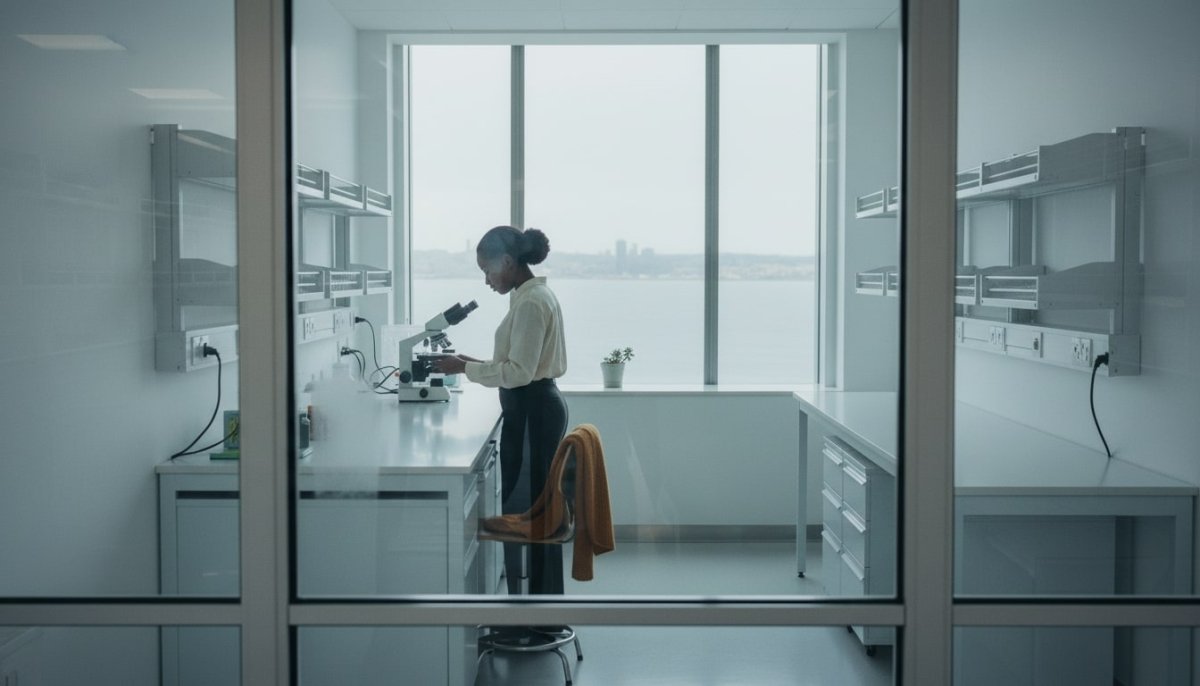
The air in the Porto laboratory smelled of coffee and sterile gloves. Amara stood at the window of the research building, gazing at the Atlantic Ocean, stretching gray and indifferent to the horizon. Behind her, the centrifuges hummed. The sound had become her second silence—a constant for the past eight months.

She had grown accustomed to many things. To the salty dampness that seeped in even through closed windows. To the Portuguese politeness of her colleagues, which was never intrusive. To the long evenings in the small apartment above the pharmacy, where the light was always a bit too yellow and the walls carried the neighbors' voices like a faint radio.
But she hadn't gotten used to being absent.
His last letter lay in her handbag, the envelope already soft from the many times she had taken it out, folded it, and put it back. She knew every word. The way he wrote "Dearest"—with a little curve on the L, as if the word were breathing. The line about the snow that had fallen in Lyon. *It's too early for winter,* he had written, *but the city doesn't seem to know it.*
Amara closed her eyes and tried to imagine Lyon. The narrow streets of the old town. The light on the Saône in the late afternoon. The small brasserie where they had shared their first kiss – between two glasses of red wine and the laughter of strangers.

“Amara?” She turned around. Her colleague Inês stood in the doorway, a folder under her arm. “The results are in,” Inês said. “Everything is ready for the presentation tomorrow.” Amara nodded. Tomorrow she would stand before the research council and summarize the data from the past few months. Then she would pack her bags. Then she would leave. “Thank you,” she said quietly. Inês studied her for a moment longer than necessary. “You’re excited, aren’t you?” Amara smiled—a small, uncertain smile that revealed more than she meant to. “Yes.” “Then go. This can wait.”
But that wasn't true. This could never wait. Research had its own rhythm, its own demands. Amara had lived in this rhythm for eight months, dissolved into it, counted the hours, and then stopped counting because counting hurt.
She stayed for another hour. Then two. When she left the building, the sky was already dark, and the wind carried the smell of salt and wet stone.
In her apartment, she packed methodically: clothes, books, the small things that made life in a foreign land bearable. She folded his letters—seven in total—and placed them between the pages of her notebook. Then she sat by the window and waited for morning.

The flight was on time. Amara sat by the window and watched the Portuguese coastline disappear beneath her. She hadn't slept. Her hands were folded in her lap, her fingers intertwined as if holding a secret. A woman beside her—older, elegant, with silver hair—smiled at her. "First trip?" "No," Amara said. "Returning home."
The word sounded strange in her mouth. Lyon wasn't her home. She'd been born in Bordeaux, studied in Paris, and moved to Lyon because a job had opened up there. But at some point, Lyon had become home—not because of the place itself, but because of him. Because of the way he made coffee in the morning without asking if she wanted any. Because of the way he listened to her, even when she talked about things that couldn't possibly interest him. Because of the way he said her name—slowly, as if tasting it.
The plane climbed higher. The clouds below looked like frozen waves. "He's picking you up?" the woman asked. Amara looked at her. "How do you know—" The woman smiled again. "You can see it." Amara was silent. She didn't know what the woman saw. Nervousness, perhaps. Or the way she checked her phone every few minutes, even though no message could come through, not up here. "It's been a long time," Amara said finally. "Eight months." Amara nodded. "That's not forever." "Sometimes it feels like it." The woman leaned back and closed her eyes. "When it's right, time doesn't matter."
Amara wanted to disagree. Wanted to say that time always played a role, that it changed things, that it distanced people, even if they physically returned. But she said nothing. She looked out the window, trying to name the fear that had been sitting in her chest for days, like a bird unable to fly. What if he was different? What if *she* was different?

Lyon-Saint-Exupéry was gray and cold. Amara carried her coat over her arm and followed the crowd through the arrivals hall. Her suitcase had a broken wheel, and the rattling echoed in her ears like a heartbeat.
She saw him before he saw her. He was standing next to the barrier, his hands in the pockets of his dark jacket, his eyes fixed on the arrival board. His hair was longer than in summer. His shoulders seemed narrower, or perhaps it was just the cut of the jacket. Amara stopped.
She had imagined this moment so many times. She had pictured herself walking, smiling, everything being easy and natural. But now, with him standing only a few meters away, she couldn't move.
Then he turned his head. Their eyes met. The world went still.
He didn't smile immediately. Instead, he looked at her as if he needed to reassure himself that she was really there. Then something in his face eased—a tension she hadn't noticed until it vanished. He approached her. Not quickly, not slowly. Just steadily.
Amara let go of the suitcase. It stood crooked, but she didn't mind. "Hello," he said. His voice was deeper than she remembered. Or perhaps she had forgotten it and had just rediscovered it. "Hello," she said.
They stood facing each other. Too close and too far at the same time. His scent was familiar—soap and something she could never name, something that belonged only to him. “You’re back,” he said softly. “I’m back.” He raised his hand, hesitated, let it fall again. “I—” “I know.”
Then he hugged her. Not gently. Not politely. He pulled her close as if he were afraid she might disappear if he didn't hold on tight enough. His chin rested on the top of her head, and she felt him exhale—a long, trembling breath that felt like relief.
Amara closed her eyes. Her arms were around his waist, and she buried her face in his jacket. She smelled the cold, and Lyon, and him. "Eight months," he murmured into her hair. "Too long." "Much too long."

They stood still as people walked around them, suitcases rolled, and voices mingled. They didn't care. When they finally broke apart, he cupped her face in his hands and looked at her. His thumbs brushed her cheekbones, a small, automatic gesture she'd almost forgotten. "You look tired," he said. "You too." He smiled. "I didn't sleep." "Me neither." "Then we should go home."
Home. The word sounded like a promise.
Outside, it was snowing. Large, slow flakes that swirled in the air before touching the ground. The parking lot was white, the cars wore caps of snow, and the air was so cold Amara could see her own breath. "You were right," she said. "It's too early for winter." "The city doesn't know," he replied, opening the trunk.
They got in. The car was warm. A crumpled map lay on the dashboard, and a small paper bag lay on the passenger seat—her seat. “What’s this?” she asked. “Open it.” Amara took the bag and unfolded it. Inside were two pains au chocolat, still warm. She looked at him. “I thought you might be hungry,” he said quietly.
Something inside her chest broke. Not painfully. Just gently, like ice melting in spring. "Thank you," she whispered. He reached out and placed his hand on hers. "I missed you." "I missed you too."
They drove through the snow-covered city. Lyon looked like a drawing—the buildings softly contoured, the streets quiet, the lights of the cafés warm behind fogged windows. Amara ate her pain au chocolat and watched the world outside. Everything felt unreal, like a dream where you're not sure whether you'll wake up or fall back asleep. "How was it?" he asked after a while. "Lonely," she said honestly. He nodded. "Here too." "Really?" "Every night."
She looked at him. His profile in the streetlights—the straight nose, the line of his jaw, the way his lips parted slightly before he spoke. “I thought you’d gotten used to it,” she said quietly. “To what?” “To my absence.” He stopped at a red light and turned to her. “Never.”
The red light cast a shadow across his face. His eyes were dark, serious. "I thought of you every day," he said. "In the mornings with my coffee. In the evenings when I came home and the apartment was empty. At night when I couldn't sleep." Amara felt her throat tighten. "Me too," she whispered.
The traffic light turned green. They drove on.
The apartment was exactly as she had left it. The same furniture, the same books on the shelf, the same soft light from the floor lamp in the corner. But something was different. It took Amara a moment to realize what it was: flowers. On the table, by the window, even on the kitchen counter. "You—" "I wanted it to be nice," he interrupted quietly.
Amara put down her suitcase. She walked to the table and touched one of the blossoms—a white rose whose petals were just opening. “It’s beautiful,” she said. He came closer, standing behind her, close enough that she could feel his warmth, but without touching her. “I was afraid,” he said softly. “Of what?” “That you’d changed. That I’d changed. That we—” He trailed off.
Amara turned around. They stood facing each other, just a breath away. "That we what?" she asked. "That we don't fit together anymore."
The words hung in the air like unfalling snow. Amara raised her hand and placed it against his chest. His heart beat fast, irregularly. "We're still okay," she said softly. "How do you know?" "Because I can still look at you like that." "How?" "Like you're the only thing that matters."
He exhaled. Then he placed his hands around her waist and pulled her closer. She put her arms around his neck, and her forehead touched his. "I've imagined this so many times," he murmured. "Me too." "Was it like that?" "No." She smiled. "It's better."
He kissed her. Gently at first, almost cautiously, as if they were getting to know each other all over again. Then deeper, more hungrily, as if eight months of longing had found a language that needed no words. Amara felt her knees buckle, but he held her tight. His hands were on her back, his lips on hers, and the world outside faded away—the snow, the city, time.
When they broke apart, they were both breathless. "Come," he said softly, taking her hand. He led her to the sofa. They collapsed together, entwined, and Amara rested her head on his shoulder. His fingers played with hers, a small, rhythmic movement that soothed her. "I never want to be gone this long again," she said. "Promise?" "I promise."

He kissed her hair. "I love you." The words were simple, but they hit her with the force of a confession. "I love you too," she whispered.
They lay there like that while the snow fell outside. The city grew quiet, the night deepened, but inside the apartment it was warm. Warm and safe and whole. Amara closed her eyes and felt the exhaustion of the past months melt away. Not all at once. But layer by layer. "Are you asleep?" he asked after a while. "Almost." "Good."
His voice was gentle. She felt his hand stroke her back, slowly, steadily, like a heartbeat. "I'm glad you're here," he said softly. "Me too." "We'll get through this." "Yes," she whispered. "We'll get through this."
And for the first time in eight months, she really believed it.
When she woke up, it was still dark. She was lying on the sofa, covered with a blanket that smelled of him. He was sitting by the window, looking out at the snow-covered street. "Can't you sleep?" she asked softly. He turned and smiled. "I wanted to make sure you were really here." Amara held out her hand. He came to her, sat on the edge of the sofa, and took her hand. "I'm here," she said. "I know." "Then come back."
He lay down beside her, and she turned to him, her face so close to his she could feel his breath. "Good morning," he whispered. "Good morning." He kissed her again, this time more slowly, as if they had all the time in the world. His hand was on her cheek, his thumb brushing her lips, and she opened her eyes just to look at him—the way he looked at her, as if she were the most precious thing he had ever held. "I don't want to be without you anymore," she said softly. "Then stay." "Forever?" "Forever." She smiled. "That's a long time." "I have time."
Outside, the sky was slowly brightening. The snow had stopped falling, but the streets were still white, and the city was slowly awakening, as if hesitating to break the spell. Amara snuggled closer to him, and he wrapped his arms around her, tight and warm. "Thank you," she whispered. "For what?" "For waiting." "I would have waited forever."
She believed him. And in that moment, in the silence of the apartment, in the soft light of dusk, in the warm embrace of his arms, Amara knew she had arrived. Not just in Lyon. But with him.