Ink in Chicago

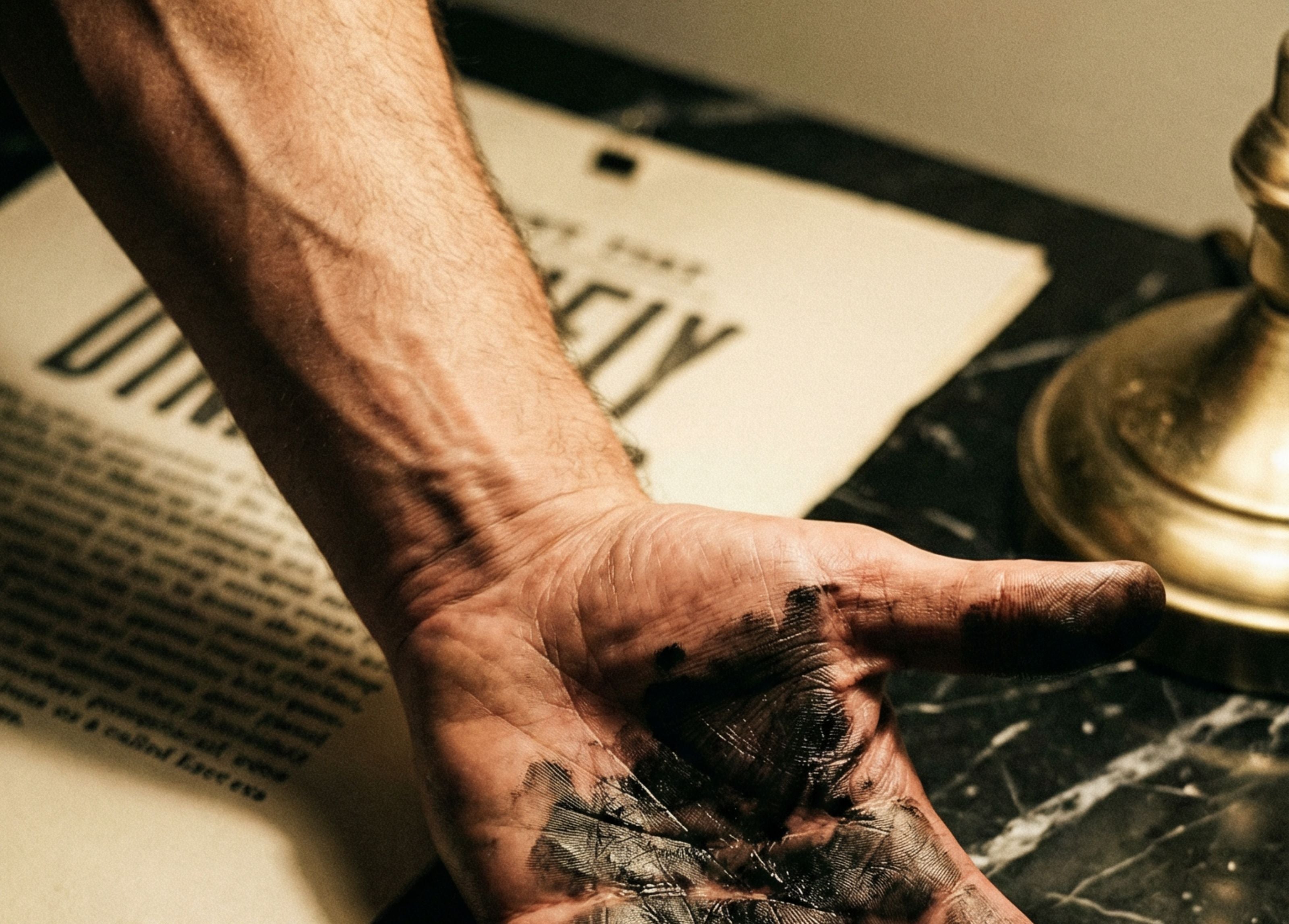
The ink on his hands was never quite dry.
That was the first thing Elara Voss noticed the evening she walked into his office, not realizing where she was going. She had been looking for the accounting room of the Alhambra Theater, an Art Deco palace on Michigan Avenue whose golden facade glowed in the November fog like a forgotten promise. Instead, she found herself in a room that smelled of cedar and cold smoke, standing before a black marble desk behind which sat a man whose hands shimmered with dark printer's ink.
He didn't look up immediately. His fingers rested on a stack of papers, the cuffs of his white shirt rolled up, and the light from the single brass lamp cast geometric shadows across his face, as if someone had painted him in amber and obsidian. The silence between them was not an emptiness. It was a room with walls.
"Accounting is two doors down," he said, without looking up.
His voice had the texture of polished stone. No accent she could place, but a precision that revealed every word was weighed before it left his mouth.
"How do you know I'm looking for accounting?"

Now he looked up. Eyes so dark that the iris disappeared into the pupil. He didn't merely observe her. He read her. Like an equation he hadn't yet solved, but whose outcome wouldn't surprise him.
"Because no one comes into this room voluntarily."
Elara should have left. Her shoes, the only pumps she owned, already worn at the heels, stood on a rug that cost more than her annual rent. Her dress, a narrow, cream-colored garment with mother-of-pearl buttons, borrowed from her landlady, didn't belong here. She didn't belong here. But her feet didn't move.
"I'm the new proofreader," she said. "For the printing press."
Something shifted in his face. Not much. A muscle in his jaw, tensing and releasing so quickly one might have missed it if not trained to read the language of bodies that didn't want to speak. Elara was trained. She had spent half her life searching for what lay between the lines in books. People were no different.
"Aurelius Blackwell," he said. No handshake. No smile. Just his name, laid down like a business card of steel. "I own the printing press. And the theater. And the building you're standing in."
And half of Chicago's South Side, she could have added. And the votes of three city council members. And the fear of men who themselves instilled fear. Elara had heard the stories before stepping foot in this building. Aurelius Blackwell, the man who didn't rule Chicago's underworld, but printed it. His newspapers shaped opinions. His printing presses produced everything from election posters to documents no one spoke about. His name was never in the headlines, because he wrote the headlines.
Forbidden attraction was a phrase Elara knew only from novels. She proofread novels. She read other women's love stories, marked comma errors, and sometimes wondered if a heart could truly race just because someone entered a room. Now she stood in a room, and her heart – no, not racing. It became still. As if someone had stopped the clock and forgotten to wind it again.
"You can start tomorrow," he said, lowering his gaze back to his papers. "Eight o'clock. Ask for Connelly."
Dismissal. As clear as the click of a lock.
Elara turned, her heels clicking on the marble floor of the corridor, and she felt his gaze on her back like a handprint that slowly faded but never quite disappeared.
The printing press was an organism of steel and noise.
Elara accustomed herself to the rhythm of the machines in the first week, to the metallic breathing of the Heidelberg presses, to the smell of printer's ink and machine oil that settled in her hair and wouldn't wash out. Her desk stood in a corner on the third floor, wedged between stacks of galleys and a window overlooking the alley where delivery trucks shared back entrances.
She proofread. That was her talent, perhaps her only one. She saw errors others missed. Not just typos or incorrect hyphenation, but the subtler breaks: where a sentence lost its logic, where an argument contradicted itself, where a secret lay between the words that the author hadn't intended to reveal.
Connelly, the foreman, a man with shoulders like a wardrobe and the voice of a tired priest, had warned her on the first day. "Correct the texts. Don't ask questions about the texts. And don't go to the fourth floor."
The fourth floor. Aurelius's office. The nerve center of everything he was and did and controlled.
Elara asked no questions. She had grown up in an orphanage in Pilsen, taught herself to read, and fought her way through her last year of university on a scholarship before the money ran out. She knew how to survive in spaces that didn't belong to her. You became invisible. You became useful. You asked no questions.
But she read.
And what she read, in the galleys that passed over her desk, was not just typography. It was speeches for politicians that hadn't yet been delivered. Business letters containing numbers that made no sense if taken literally, but perfect sense if one understood that numbers could also be codes. Articles that disguised facts as opinions and opinions as facts. And sometimes, late at night, when the presses were silent and only the hum of the lightbulbs could be heard, documents without sender or recipient, only with a series of initials she couldn't identify.
Elara corrected the commas. She marked incorrect subjunctives. And she began to remember things she shouldn't have remembered.
At the end of the second week, he came to her.
She heard his footsteps before she saw him. Not heavy, not quiet, but steady, like the ticking of a clock that never lagged. He suddenly stood at her desk, and his shadow fell across her galleys, and the air changed. Not the temperature. Something else. The density.
"You missed a mistake," he said.
He laid a sheet before her. Elara reached for it, and her fingers brushed his, and the ink on his skin was damp, and for a fraction of a second, she felt the warmth beneath, the warmth of a man who drank too much coffee and slept too little, and whose pulse sat exactly where her finger had touched the back of his hand.
She withdrew her hand. Not quickly. Slowly enough not to look afraid. Quickly enough for him to notice.
"Page three, third paragraph," he said. "The 'sein' should be 'seinen.' Case."
Elara looked at the sheet. He was right. It was a simple declension error she had overlooked because she had instead read the content of the paragraph, which was about a property transfer in Bridgeport where the sums mentioned didn't match the square footage given.
"Proofreaders read letters," Aurelius said. His gaze rested on her like a weight. "Not meanings."
It wasn't a question. It was a warning. And in the way he uttered it, there was something she couldn't identify. Not a threat, not quite. More like a door he showed her, which she wasn't allowed to enter, and at the same time the silent question of whether she would go through it anyway.

"I will correct the error," Elara said.
He stood there for another moment. The light from the corridor behind him outlined his silhouette in harsh, geometric lines, as if he himself were part of the architecture, a beam without which the building would collapse.
Then he left, and the air in the room took a while to feel normal again.
It began with the marginalia.
Elara found them on the third page of a manuscript she was proofreading late at night, long after the printing press was empty. Handwritten notes in the margin, in a script she now knew. His script. Not the official annotations for the typesetter, but personal thoughts, accidentally or deliberately left in the galleys.
"Truth is not a weapon. It is a curse. He who speaks it must be prepared to stand alone."
Elara stared at the sentence until the letters blurred before her eyes. It was as if someone had opened a window in a room she had thought windowless. Aurelius Blackwell, the man who printed Chicago, the man whose name inspired fear, wrote philosophical marginal notes on proof sheets.
She flipped through. On the seventh page, she found another.
"Power is the most perfect form of loneliness."
Her breath hung in the cool air of the office for a moment. The heating on the third floor only worked until eight in the evening, and after that, the November chill crept through the window cracks, and Elara wrapped herself in the wool scarf she never took off, and read on, and the marginalia spoke to her like a voice too proud to be loud.
She began to answer him.
Not directly. Not in words that could be called a conversation. But by underlining his marginal notes with a thin pencil stroke and leaving her own notes beside them, so tiny one needed a magnifying glass.
Under "Truth is not a weapon," she wrote: "But neither is silence."
Under "Power is the most perfect form of loneliness," she wrote: "Only if directed against others."
It was madness. It was the silliest thing she had ever done. It was the only moment of the day when she felt she was talking to someone who understood her.
The galleys came back. With new marginalia.
"You're still reading meanings."
And below it, in a script less controlled than anything she had seen from him before:
"Don't stop."
The threshold shifted.
It didn't happen on a particular day, not at a particular moment, but in the sum of small shifts, like a building settling by millimeters until one morning a crack appears in the wall. He came to the third floor more often. Not always to her, but always near her. He stood at the window, looking out at the alley while she proofread, and his silence had a different quality than the silence of the machines. His was inhabited.
Sometimes they talked. About typefaces. About the sharpness of the new lead type. About whether Garamond or Bodoni was better suited for a political pamphlet. And in these conversations, which revolved around typography, they talked about everything else.
"Garamond lies more elegantly," he said one evening.
"Bodoni is more honest in its exaggeration," she replied.
He looked at her. In his gaze was something she had never seen in a man. Not hunger, not calculation, not that kind of interest she knew from dance halls and job interviews. It was wonder. As if he had believed he knew all the world's typefaces, and she had just invented a new one.
"You are dangerous, Elara Voss."
It was the first time he used her first name. And the way he pronounced it made it a different word. One she had never heard and immediately wanted to hear again.
"Because I know typefaces?"
"Because you understand what they hide."
The silence afterward was not empty. It was charged, like the air before a thunderstorm over Lake Michigan, when the sky turns the color of tarnished silver and you don't know whether to open or close the window.
Three weeks after her first day, Elara found the document.
It lay between two galleys that were clearly not meant for her. A list of names. Next to them, amounts. Next to them, dates that lay in the future. And at the bottom, in Aurelius's handwriting: "Costs of silence."
Elara knew what it was. Not in detail, not in the legal categories needed to name it in court. But she knew what it meant. It meant that Aurelius Blackwell didn't just print newspapers. He printed the silence of an entire city.
Her hands didn't tremble. That surprised her. She put the document back. She returned to her desk. She corrected a comma on page four and noticed that her handwriting was unchanged, neat and even, as if she had seen nothing.
But her stomach was a knot, and her mouth tasted of copper, and the marginalia she left on his galleys that evening remained blank that night.
He noticed it the next morning.

She knew because he entered the third floor and walked directly to her desk, picked up the galleys, and looked at the empty margins as if they were pages from which someone had torn words. His jaw was clenched. Not in anger. In something else.
"You stopped writing."
"I did my job."
"That's not what I mean."
Elara looked up. In his eyes was something she had never seen and that frightened her because it was honest. Aurelius Blackwell, the man who managed others' fear like capital, was afraid. Of her. Of what she knew. Of what she no longer said.
"Come with me," he said.
It wasn't a command. It was a request, disguised as a command, because he didn't know how to ask.
The fourth floor was smaller than she had expected.
No throne room. No gold-embellished display of power. A room with tall windows through which the gray light of the November sky fell, a desk, two chairs, shelves full of books, and on the wall a single painting showing a woman with her back to a mirror. The colors were dark, ocher and black, but the light in the picture came from within, as if the woman carried her own sun.
"My mother," Aurelius said. "She couldn't read. But she always knew when someone was lying."
Elara stood in the middle of the room. Between them, the desk. Between them, the list of names. Between them, everything they knew and couldn't express.
"You saw the document," he said. Not a question.
"Yes."
"And you stayed."
"I went back to my desk and corrected a comma."
Something twitched in his face. A smile, as brief and rare as sunlight in December.
"Why?"
Because I was afraid. Because I didn't know where else to go. Because I wanted to understand why a man who could buy the silence of a city searched for truth in the margins of proof sheets.
"Because I wasn't finished reading yet," she said.
He came around the desk. Slowly. Not like a man taking, but like a man approaching an animal that could flee at any moment. He stopped a step in front of her. Close enough for her to breathe in the scent of ink and cedar. Close enough for her to see the shadows under his eyes, the lines that came not from harshness, but from sleeplessness.
"I can't be a good man, Elara. The empire I run doesn't allow it."
"I wasn't looking for a good man."
"What then?"
"An honest one."
His breath hitched. Briefly. Like a sentence missing its last word.
Then he raised his hand. Not to her face. To the wool scarf around her neck. His fingers touched the wool, and the gesture was so cautious that Elara understood: This man, who owned entire city districts, asked for permission before touching a scarf.
"You always wear it," he said.
"It belonged to my mother."
That wasn't entirely true. It belonged to a woman in the orphanage who had assigned Elara the bed next to hers for three years and who one morning was simply no longer there—just as people in Elara's life were never there again—without explanation, without farewell, just an empty mattress and a forgotten scarf that smelled of lavender and loss. But Elara had learned that some truths were simpler than others, and sometimes the simpler ones seemed more honest.
Aurelius released the scarf. His arm dropped to his side, but he did not step back, and the distance between them remained what it was—a promise and a threat at the same time.
"Whatever you saw," he said, "I can't undo it. And I won't ask you to forget it."
"What do you ask me then?"

"To understand that there are things that are necessary."
"Necessary." The word tasted bitter in her mouth. "That's what all men say who do things they can't justify."
Something changed in his face. Not the controlled coldness she knew from him. Something rawer. Like a sentence someone sets and then removes from the printing block before it hits paper.
"Ask me," he said. "Whatever you want to know."
The invitation hung in the air like the smell of fresh printer's ink—sharp, chemical, and with the promise that something permanent would emerge once it touched paper.
Elara knew she should have left. Back to the third floor, back to her commas and subjunctives, back to the invisibility that kept her alive. Instead, she sat in the chair in front of his desk, crossed her legs, folded her hands in her lap, and looked at him as one looks at a manuscript one opens for the first time.
"The list," she said. "The names. What happens to them?"
He did not sit. He leaned against the desk, his hands on the edge, his knuckles white, and the ink on his fingers was almost invisible in the gray November light.
"Chicago is a city built on compromise," he said. "Not on laws. Not on morality. On agreements between men who have enough power to write the rules and enough sense never to write them down." He paused. "My father understood that. He came from Alabama. Without a name, without money, without the skin color that opens doors in this country. He built this printing press by printing things others didn't want to print. Flyers for the unions. Newspapers for the South Side. And eventually things for men who paid him not to ask questions."
"And you?"
"I asked the questions. And then I understood that in this city, you either print or you get printed."
It wasn't an apology. It was an explanation as precise as a sentence correction—not a word too many, not a word too few, and the truth lay not in what he said, but in what he omitted.
"The names on the list," Elara said. "Are they people who are silenced?"
"They are people who are paid for their silence. That's a difference."
"Is it?"
He looked at her. For a long time. And in that gaze was no manipulation, no strategy. Only the naked, terrifying honesty of a man telling someone the truth for the first time in years, and realizing he had forgotten how to do it.
"No," he said. "Probably not."
Elara stood up. Not to leave. To come closer. She stepped to the desk, next to him, her shoulder inches from his arm, and she could see his pulse where his shirt collar left his neck bare—faster than expected, like a metronome someone had set to a pace it couldn't maintain.
"Why are you showing me this?" she asked. "Why are you telling me about it?"
"Because you're the only one who answers my marginal notes."
The words hit her with an impact she hadn't expected. Not because they were dramatic. But because they were simple. Because Aurelius Blackwell, the man who controlled the language of an entire city, had just told her he was lonely, in the only way he knew—by not saying it, but showing it.
She raised her hand. Slowly. And placed it on his, which lay on the desk edge. Her fingers over his. The ink beneath her fingertips, warm and smudged and alive.
He didn't move. Didn't breathe. And then, with a slowness that revealed how much control it cost him, he turned his hand beneath hers, and their palms lay together, and his fingers closed around hers, and the gesture was so small and so enormous that the November light through the windows seemed brighter for a moment.
"You shouldn't do that," he said.
"Probably not."
"I'm not a safe man, Elara."
"I'm not a woman looking for safety. I'm looking for truth. And you've just said more of it than anyone I know."
He closed his eyes. One breath. Two. And when he opened them again, there was something in them she had never seen—not in him, not in any man. It was surrender. Not the kind that had to do with weakness, but the kind that had to do with courage. The surrender of a person who stops fighting against the only thing stronger than himself.
He didn't kiss her in that moment. That would have been too easy, too fast, too cheap for what lay between them. Instead, he lifted her hand and brought it to his mouth, pressing his lips to her knuckles, once, and his breath was hot on her skin, and the gesture was so old-fashioned and so devastating that Elara held her breath and forgot to exhale.
"Tomorrow," he said against her skin. "Come at nine. Not to the third floor. Here."
He released her hand. Stepped back. And the distance between them was there again, correct and professional and as thin as a page of the finest paper.
Elara left. Down the stairs, through the corridor, past the sleeping presses, out into the November night, where the wind blew from Lake Michigan and smelled of ice and beginnings. She walked three blocks before she stopped, leaned against a house wall, and realized her knees were trembling.
Not from fear. From something that had no name and that she felt for the first time in her life, and it felt like the opposite of invisibility.
The next morning, she sat in his office, reading.
Not proof sheets. The books on his shelves. He had offered it to her, casually, as if it were nothing, and she had pulled out a volume by Langston Hughes and opened the pages, and the marginalia in it were his, and she read his thoughts between the printed lines, and it was more intimate than any touch.
He worked. She read. The November light moved across the floor. Between them, nothing but silence and the kind of presence that said more than words.
After two hours, without looking up, he said, "Hughes has three errors on page thirty-seven."
"Two," Elara said. "The third is intentional."
He looked up. And there it was again – the smile that wasn't a smile, but a break in the facade through which light fell.
So began their mornings. Nine o'clock, fourth floor, his office, which was not a throne room, but a hideout. She read. He worked. Sometimes they spoke – about books, about typefaces, about whether a thought lost its value when written down, or gained it only then. And in these conversations, which revolved around words, they spoke about everything they couldn't say to each other.
Connelly noticed it first.
"You're spending time with him." Not an accusation. A statement, as sober as a list of errata.
"He lets me read books."
Connelly looked at her, and in his tired eyes was something that was worry and warning and perhaps even sorrow, as if he had seen this story before and knew how it ended.
"In thirty years, I haven't seen a single person he's allowed into that room. Not one." He lowered his voice. "Be careful what you find in there."
"Books?"
"Him."
On the third Friday in November, as the first snow fell over Chicago and enveloped the city in a silence unlike any other silence—whiter, purer, as if one could see the stillness—Elara went to his office and found the door locked.
She knocked. Nothing.
Knocked again. And heard something she had never heard before. Glass hitting marble. Not shattering. Striking and rolling and coming to a stop, and behind it a breath too controlled to be natural.
"Aurelius."
It was the first time she had used his first name. It peeled from her lips like a seal detached from a letter, and the weight of the name surprised her—heavier than expected, fuller than expected, and the way it echoed in the silence of the hallway made it a confession.
The door opened. He stood behind it, his shirt crumpled, cuffs not rolled up, hair disheveled. His eyes were red. Not from tears. From hours of not blinking, staring at something he didn't want to see.
On his desk lay a newspaper. The Tribune. Front page. A photo of a man Elara didn't know. Below it, the headline she didn't need to read to understand: a name, a date, the word "dead."
"Someone you knew?" she asked.
"Someone I could have warned." His voice was as flat as newly set type. "His name was on a list. A different one than you saw. One I should have published. One I didn't publish. Because the consequences—"
He broke off. Turned to the window. The snow fell in diagonal lines, as if someone had italicized the world.
Elara stepped in. Closed the door. Went to him. Not to the desk, not to the chair. To him. She stood next to him at the window and watched the snow, and her shoulder touched his arm, and she stayed.
"You shouldn't have come," he said.
"And you shouldn't have opened the door."
"I know." A pause. "I know."
They stood at the window, and the snow fell, and Chicago disappeared under a layer of white that covered everything—the dirty sidewalks, the coal smudges on house walls, the traces of the day before. And Elara thought that snow was the only correction the world knew: a clean page laid over a written one, errors not erased, but hidden, until the warmth came and revealed everything again.
"Tell me about him," she said.
And he did. Not everything. But enough. A man named Ellis, who had run a school on the South Side, who had known too much about city council dealings, who had become too loud. Aurelius had the information. The evidence. The ability to print everything, expose everything, destroy everything these men had built. But the printing press was part of the same system. And the printing press fed two hundred families. And the choice had not been between good and evil, but between two kinds of guilt.

"I kept silent," he said. "And now a man is dead. And the silence is my fingerprint on the weapon I didn't hold."
Elara took his hand. Not the clean one. The one with the ink. And she held it tight, feeling the pulse beneath the smudged skin and the coldness of his fingers and the way they trembled, barely perceptibly, like a printing plate shifting by a fraction of a millimeter and changing the whole image.
"You can't unset the past," she said. "But you can write the next page differently."
He looked at her. And what she saw in his eyes was not the man who printed Chicago. It was the boy who had watched his father set type, letter by letter, and who had learned that words were humanity's most powerful and dangerous invention. It was a man collapsing under the weight of his own power, and who for the first time had someone who didn't look away while it happened.
He rested his forehead against hers. And she allowed it. And for a moment, the world was only this room, this window, this snow, and the warmth of two breaths mingling.
Then he kissed her.
Not like a man taking. Like a man giving. His mouth on hers was a confession, soft and smoky and tasting of cold coffee and something darker she couldn't name, but that tasted of him—of ink and cedar and the burden of choices that had no right outcome. His kiss was neither a beginning nor an end. It was a semicolon—the point where the sentence could have ended, but continued because there was still something to say.
Elara placed her hands on his face. Felt the stubble beneath her palms, the line of his jaw, the spot behind his ear where the skin was softer than anywhere else. And she kissed him back, and it was like opening a book you know will change you—with fear and with hunger and with the certainty that there was no going back once the first page was read.
When they broke apart, he held her hands tightly, her fingers entwined with his, ink on both.
"The world won't understand this," he said.
"The world doesn't understand marginalia. That doesn't mean they don't exist."
He closed his eyes. And for the first time since she knew him, he looked like a man who was sleeping. Not sleeping, but could have slept. As if something in him had given way, a gear that finally disengaged.
December came, and with it the cold that transformed Chicago into a city of iron and frost. The heating pipes in the printing press creaked like old bones, and breath hung in clouds over the presses, and Elara drew her wool scarf tighter and worked, and the mornings on the fourth floor became something she didn't want to name, because naming meant control, and control was the opposite of what lay between them.
They did not lie with each other. Not immediately. Not in those first weeks, which consisted of glances and touches so brief they could have been accidental—his hand on her back as he passed her. Her fingers brushing his cuff as she handed him a galley. Once, on an evening when the print shop was empty and the presses were silent and the building was so still you could hear the pipes ticking, she leaned against his shoulder as they both stood at his desk reading a manuscript, and he put his arm around her, and they remained so, side by side, reading, and the light from the brass lamp cast their shadows as a single silhouette on the wall.
"The world out there," he said one evening, as the snow fell so thickly that the streetlights became ghosts, "knows me as the man who inspires fear."
"And in here?"
"In here, I'm the man who is afraid."
Elara turned to him. His face was close, the shadows under his eyes deeper than in the morning, and she saw the fine lines around his mouth, which came not from smiling, but from clenching, and she thought: This is what a man looks like who has been strong his whole life and who is tired of it.

She kissed him. This time it was she who began. Her mouth on his, soft and determined, and he made a sound she had never read in all the books she had ever proofread—between breath and word, between control and surrender, and his hands came to her waist, and she felt the ink on his fingers through the fabric of her dress, imprints he left without knowing it.
He paused. Forehead to forehead. His breath on her lips.
"I have nothing clean to give you," he said.
"I wasn't looking for clean. I was looking for real."
He led her to the window. Not to the desk. Not to the floor. To the window, where the city lay beneath them, in snow and darkness and the distant light of Michigan Avenue, and he stood behind her and wrapped his arms around her, and his mouth was at her temple, and she leaned against him, and the windowpane in front of her was cold and his body behind her was warm, and for a moment she was enclosed between the world and him, and she chose him.
His hands, the ink-stained hands, slid over her arms, over the silk of her collar, and his lips found the spot behind her ear, and she closed her eyes, and the city disappeared, and there was only his voice saying her name, once, as if it were a word he had just invented and that existed only in that room.
What followed was not intoxication. It was a translation. Of everything they had written to each other in marginalia, into a language that needed no letters. His hands on her skin, slow and attentive, as if reading each line individually. Her fingers in his hair, which was softer than she expected. His mouth on her collarbone, where the wool scarf ended and her skin began, and the sound she made—soft, unplanned, honest—that made him pause for a second before he continued.
And on the narrow sofa next to his desk, beneath the painting of his mother with her back to the mirror, they found each other—not perfectly, not smoothly, but with the raw honesty of two people who had been alone for too long and who didn't know how to be close without being vulnerable, and who tried anyway, because the alternative was worse.
Afterward. Silence. Not the inhabited silence of their mornings. A new kind. Lighter. Like the page after the last sentence of a chapter, still blank and waiting for the next word.
He lay on his back, her head on his chest, and she heard his heartbeat and thought it sounded like the beating of the presses—steady, reliable, with a force more felt than heard.
"The list," she said.
He stiffened. Barely perceptible, but she was on his chest and felt every muscle.
"What about it?"
"You have to print it."
Silence. His heartbeat, faster now.
"If I do that, I lose everything. The printing press. The theater. The newspapers. The men on that list will—"
"I know what they will." Elara propped herself up and looked at him. "And I know what you'll be if you don't. You'll be the man who writes marginalia no one reads. You'll be the man who knows the truth and locks it away. You'll be—" She paused. "You'll be your own father."
The words landed like lead on paper. Heavy. Permanent.
He sat up. Ran his hand through his hair. The ink on his hands was smudged, and Elara saw her own skin, where he had touched it, and on her forearm was a fingerprint of printer's ink, his imprint, as if he had printed himself into her skin like a word onto a page.
"You know what they'll do to me," he said.
"Yes."
"And you're staying?"
"I'm staying."
He looked at her. For a long time. And then he stood up and went to the desk and opened the bottom drawer and took out a stack of papers thicker than the list Elara had seen. Much thicker.
"It's not just a list," he said. "It's three years. Properties. Elections. Bribes. All documented. All ready to print."
Elara stood up. Wrapped the wool scarf around her neck. Sat down at the desk and took the first sheet.
"Then it needs a proofreader," she said.
They worked three nights.
The print shop was empty, Connelly had sent the workers home, and only the emergency lights were on, orange bulbs bathing the stairwell in copper light. Elara proofread. Not just commas and declension this time, but structure, logic, chains of evidence. She restructured the text, like rebuilding a foundation—piece by piece, sturdy enough to bear the weight of the truth that would stand upon it.
Aurelius set type himself. Not the big presses, but his father's old lead type, placing letters one by one into the composing stick, line by line, and the clicking of the type was the only sound in the silent print shop, and it sounded like rain on a tin roof, steady and unstoppable.
Connelly came on the second night. Stood in the doorway of the composing room, watched Aurelius at the type, watched Elara over the galleys, and his face was as still as a page from which someone had erased the last sentence.
"What are we printing?" he asked.
"The truth," Aurelius said.
Connelly was silent for a moment. Then he took off his jacket, rolled up his sleeves, and stepped to the press.
"Then we need better paper," he said.
On the third evening, when the last page was printed and the smell of fresh printer's ink hung so thick in the room you could taste it, Aurelius stood before the stack of finished copies and laid his hand upon them. His fingers trembled. Not from fear. From something beyond fear.
Elara stepped beside him. Placed her hand on his. Ink on ink.
"You know what happens tomorrow," he said.
"Yes."
"You know nothing will ever be the same."
"Nothing ever was the same. We just pretended."
He turned to her. And in his face was something she saw for the first time—not the smile that was a crack in the facade, but a smile that replaced the entire facade. Real. Complete. The smile of a man doing something for the first time in his life that wasn't smart, wasn't safe, wasn't calculated, but right.
"Elara Voss," he said. "You are the most dangerous thing that has ever happened to me."
"And you are the only person who answered my marginalia."
He kissed her. Between the printing presses, in the scent of ink and paper and the echo of the machines that had been silent and would speak again tomorrow. He kissed her, and she kissed him, and it tasted of ink and beginnings and the courage it took to print a truth that cost everything.
The issue appeared on Monday.
Two thousand copies. No name on the imprint. Only a sentence on the last page, in his handwriting, which she now knew as well as her own: "Truth is not a weapon. It is a curse. But silence is worse."
Elara stood at the fourth-floor window, watching the newsboys carry stacks into the streets. The snow had stopped. The sky over Chicago was cloudless and cold, a blue so sharp it stung the eyes, and the city lay bare and open, and for the first time Elara saw it as it truly was—not golden, not dark, but both at once, and beautiful in its contradiction.
Aurelius stood behind her. His arm around her waist. His mouth at her hair.
"They'll come," he said. "Today."
"I know."
"I can't promise it will end well."
"I wasn't looking for promises."
"What then?"
She turned in his arms. Looked at him. The dark eyes, in which there was no fear anymore, not because it had disappeared, but because it had changed its place, just as Elara had changed hers—from invisibility to light, from correction to text, from the margins to the center.
"For the next sentence," she said.
He smiled. The real smile. The one that replaced the facade.
And below them, the city began to read.
Three months later.
The printing press still existed. Smaller. Poorer. The big contracts were gone, the political pamphlets, the lucrative business letters with the coded numbers. Instead, it now printed a weekly newspaper that set truth in Garamond, because Garamond lied elegantly and truth needed all the elegance it could get.
Aurelius had lost the theater. And the building on Halsted Street. And three of his four cars. He had won one lawsuit and survived two threats and lost a friend who hadn't been a friend. He had grown thinner and quieter and, in a way that sometimes frightened Elara, content.
She still worked on the third floor. But the mornings on the fourth floor were now hers. And sometimes, late at night, when the presses were silent and the building breathed and the light from the brass lamp cast their shadows on the wall, she sat beside him at the desk, correcting his editorials, and he read her annotations, and they argued about commas and subjunctives and whether truth didn't appear more honest in Bodoni.

The wool scarf hung on the hook beside the door. Elara no longer needed it to keep warm.
On the margin of his latest galley, she found a note, in his handwriting, which was no longer as controlled as it had been at the beginning:
"The ink on my hands never dries. But since you've been here, it doesn't bother me anymore."
And below it, in her script, so small you needed a magnifying glass:
"It never bothered me."