
Dead since 1984

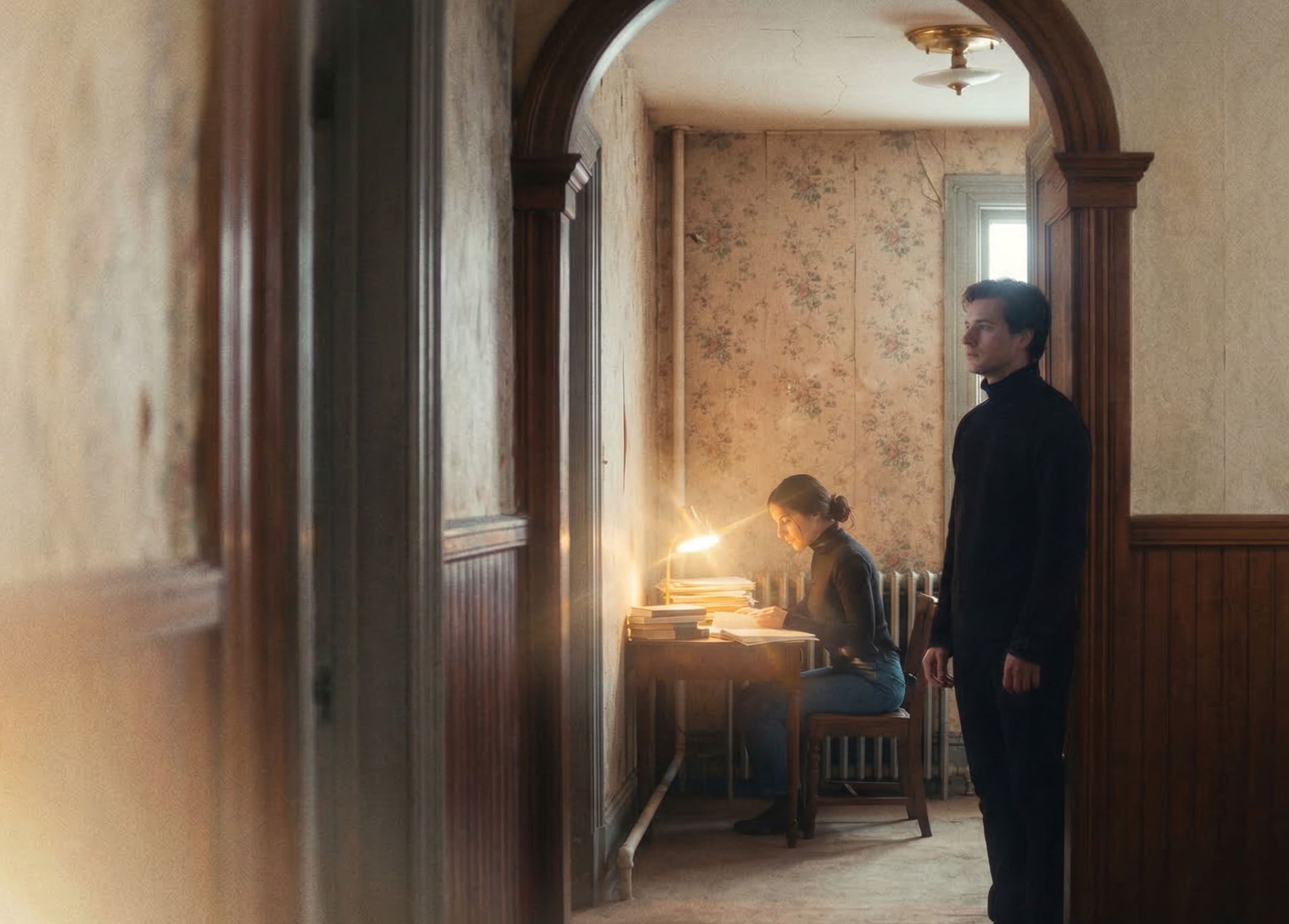
Montreal, March 1987. The Victorian house on Rue Saint-Denis has stood for decades between two worlds, too old for the modernizers, too dilapidated for the nostalgics. The wooden floorboards creak in a language no one understands anymore. The windows are blinded by cold, inside and out.
Nadia finds the room on the second floor on a Thursday. The landlady, a woman with tired eyes and a cigarette that never quite goes out, shows her the room with a hand gesture that explains everything and nothing.
"Three months in advance. No parties. The other tenant is quiet."
"How quiet?"
"You will hardly notice him."
That's a lie, but not a malicious one.
On the first night, Nadia hears footsteps. Not the heavy thumps of a man coming home, but the steady up and down of someone who can't sleep. She turns onto her side and counts the intervals. Seven steps. Pause. Seven back.
The kitchen doesn't smell of coffee in the morning.
She notices it because the cup is on the table, steaming, black, untouched.
"Good morning," she says into the void.
"Morning." The voice comes from the hallway. Dry, without melody.
He leans against the wall next to the door, arms folded. Theo. That's how he introduces himself, without extending his hand. He's wearing a black turtleneck sweater, as if it were still winter outside, and perhaps for him, it is.
"You made coffee."
"Yes."
"Aren't you drinking it?"
"I like the smell."

That's strange enough that Nadia doesn't ask any further questions. She pours herself a cup. The coffee is perfect. Too perfect for someone who isn't drinking it.
Theo isn't there during the day. Or he is, but invisible. Nadia is working on her dissertation about the architecture of Victorian working-class neighborhoods in Montreal. She sits at the table in her room, surrounded by photographs and floor plans, and sometimes, just sometimes, she feels someone standing behind her.
When she turns around, there's no one there. But the air feels different. Thicker. As if someone had just exhaled.
On the seventh day, she confronts him.
It's late. She comes out of the library, her fingers stiff from the cold, and finds him in the kitchen. He's standing by the window, his hands in his pockets, looking out at the street, even though there's nothing to see but sleet.
"Theo."
He doesn't turn around.
"You never shower. You never cook. I've never seen you sleep."
"I am a light sleeper."
"That's not an answer."
Silence. The refrigerator hums. A tap drips somewhere.
"You're dead, right?"
He turns around. Slowly. His eyes are dark, not threatening, but exhausted in a way that has nothing to do with lack of sleep.
"Since 1984."
Nadia waits for her heart to skip a beat, for panic to set in. Instead, she just nods.
"Heart attack?"
"Yes. I was 32."
"And you stayed here."
"I died here. In the stairwell, on the way down. Nobody found me until it was too late."
She sits down on the kitchen chair. Her legs are trembling, but not with fear. With something else. Relief, perhaps. That she's not crazy. That the things she'd felt were real.
"Why can't you leave?"
"I don't know." His voice trails off. "Or I didn't know. Until you came."
They start spending time together. Not intentionally. It just happens. Nadia works at night because the silence helps her think, and Theo is awake at night because he always is. He knows the house inside and out, the cracks in the walls, the places where the plaster crumbles, the history of every room.
"A family with four children lived here," he says, pointing to a corner of the living room. "The mother sat by the window and sewed. Every evening."
"How do you know that?"
"I was the architect. I designed this house."
Nadia stares at him.

"You built it?"
"No. I drew it. Someone else built it. But I planned every inch of it."
She understands now why he stayed. Not out of duty. Out of love. That quiet, unspoken feeling that architects have for their buildings, as if they were children they release into the world and never see again.
"Help me," she says one evening.
"Where?"
"With my work. You know the story. I need sources that no longer exist."
He hesitates. Then he nods.
The weeks pass. Nadia learns to read his presence. The slight drop in temperature when he enters a room. The scent of paper and old wood he carries with him, even though he can't touch anything but her.
They discover it by chance. She trips over a stack of books, and he catches her. His hand around her wrist. Cold, but firm. Real.
They both look at the touch. Then at each other.
"How?"
"I don't know."
But they both know it. It's her. Her vibrancy. Her warmth. She makes him visible. Tangible. Almost human.
After that, they touch each other more often. Small things. His fingers brushing a strand of hair from her face. Her hand gliding over his arm, just to feel his presence. It's not sexual. Not yet. But it's intimate. An intimacy that feels dangerous because it has no future.
In April, Nadia finds a letter in his desk drawer, the only one she shouldn't open. The letter is unopened, the ink faded. The address is the house's. The sender is a woman named Claire.
"Who is she?"
Theo is sitting on the windowsill. It's raining outside. The water runs down the pane like tears that the glass weeps, not him.
"Someone I knew."
"Someone you loved."
"Yes."
The word lies between them like a stone.
"And you're waiting for her."
"No." He turns to her. "That's what I believed. For years. That I was here because I never told her how I felt. That I had to stay until she came back so I could finally say it out loud."
"But?"
"She never came back. And at some point, I stopped waiting."
Nadia felt something tighten in her chest. Not jealousy. Something worse. Hope.
"Then why are you still here?"
"Because I was waiting for you."
The air disappears from the room. Or she's breathing in too quickly. She doesn't know.
"That's not fair."
"I know."
"You can't just..."
"I know."
She turns around, about to leave, but his hand closes around hers. This time his touch isn't cold. It's warm. Almost alive.
"Nadia."
She looks at him. Really at him. The lines around his eyes, the shadows under his cheekbones, the way he looks at her as if she were the only thing still tying him to this world.
"I can't give you a future," he says quietly. "But I'm here. Now. If you want me to be."
"That's not enough."
"I know."
But she doesn't withdraw her hand.
They kiss on the night before Halloween. Samhain. The boundary between the worlds is thin, legend says. Perhaps that's true. Perhaps that's why his lips don't feel like shadows, but like flesh. Why his hands, gliding down her back, leave a mark. Why she can feel him, truly feel him, as if he were alive.
They make love on the bed in her room. Slowly. Carefully. As if the world were made of glass and could shatter at the slightest wrong move. He trembles beneath her hands, and she understands it's not cold that makes him tremble. It's fear. The fear that this will be the only time. That morning will take everything the night has given them.
But she doesn't let him disappear. She holds him tight. Her hands in his hair, her legs around his hips, her breath against his ear.
"Stay," she whispers.
And he stays.

He's still there in the morning. Not as a ghost. As a man. His skin is warm against hers. His heartbeat, she can't feel it, but she thinks she can hear it. A faint, impossible throb.
"How long will this take?"
"I don't know."
"Hours? Days?"
"I don't know, Nadia."
She kisses him anyway. Because it doesn't matter. Not really. What matters is that he's here. That she can feel him. That the impossibility between them no longer has a place, not now, not in this moment.
The transformation lasts three days. Then the cold begins to return. First his fingertips. Then his hands. Then his whole body.
He isn't crying. But she sees it in his eyes. The fear that she will see him differently now. The grief for what is being lost.
"It's okay," Nadia says, taking his cold hand.
"But..."
"It's okay." She pulls him closer. "I'll stay."
She doesn't pack her things. She stays. Because giving up would feel like a betrayal. Of him. Of herself. Because three days have shown her what's possible, and that's more than she ever hoped for.
They find a rhythm. They live side by side. She in the world of the living, he in the in-between. But there are moments, when the moon is full, when the night is still enough, when they both want what they cannot have, when the boundaries blur. Then she can hold his hand. Then he can feel her breath.
It is not enough. It will never be enough.
But it is something.
And sometimes it's more than the world gives most people.
In June, when the sun warms the streets and the windows of the house shine again, Nadia sits down at her desk and writes the last pages of her dissertation. Theo stands behind her, his hands on the back of her chair. She feels him. Not as coldness. As presence.
"Thank you," she says quietly.
"For what?"
"That you waited."

He doesn't answer. But his hand glides over her shoulder. A touch that feels almost warm. Almost alive.
And that's enough.
For now.
✧ Text, images and narration of this story are created with the help of AI. Curated and edited by Narrabelle. How we work


