Silent Pages

Read it yourself
The espresso cup tipped over. Sophia caught it just before the rest spilled over her notes. Her hand trembled.
She pressed her palms to the cool tabletop. A deep breath. Just a glance. Nothing more.
But he had looked back.
March light streamed in through the tall windows on the second floor at harsh angles. The reading room smelled of floor wax and yellowed paper. Sophia stared at the manuscript in front of her—a 14th-century copy of Petrarch—and couldn't understand a single word.
Three tables away, he turned a page. The paper rustled.
She had seen him for the first time two weeks ago. Faded linen shirt, sleeves rolled up. Dark hair that fell across his forehead when he bent over his books. She hadn't looked. Not really. Just those peripheral glances when she got up to fetch a book. When she rubbed her eyes. When she looked out the window.
This morning he had lifted his head, just as she looked over at him.
Her ink smeared on the index card.

The scraping of a chair. Footsteps on the parquet floor.
Sophia didn't lift her head. She saw brown leather shoes with dust stains. Long fingers holding an open book.
"Excuse me." A warm voice, a slight accent. "This paragraph—do you know the source?"
She had to swallow before she looked up.
Narrow face. High cheekbones. A small scar above the right eyebrow. Eyes so dark they seemed to absorb the light.
The book in his hands was open to a commentary on Petrarch's sonnets. She recognized the handwriting – she had transcribed the same passage two weeks earlier.
"Codex Riccardiano," she heard herself say. Her voice sounded more foreign than she intended. "Fourteenth century. The marginal note probably originates from Padua."
His smile reached his eyes. "Grazie."
A pause. He didn't move.
"Do you also work on Petrarch?"
"Translation errors in transcripts." The words came automatically. "How meaning shifts."
"Loss of control."
Not a question. A statement.
Sophia felt something tighten in her chest. "Transformation."
He nodded as if she had passed an exam. His hand moved towards the chair opposite – a gesture, not a demand.
She nodded.
He sat down. There was too much distance between them for a conversation. And at the same time, far too little.
"Mateo."
"Sophia."
Outside, the bells of Santo Spirito were ringing. The sound penetrated the thick walls faintly.
"You come here every day," he said.
"You too."
"I thought I was the only one who mattered."
Something inside her chest leaped open. Like a door that had been locked for too long.

The next day he waited in front of the library.
He leaned against the stone wall, a newspaper in his hand which he wasn't reading. When Sophia came through the door, he folded it up.
"Coffee?"
She should have said no.
"Yes."
They walked through the narrow streets of San Frediano. Laundry hung between the houses. The smell of fresh bread wafted from open doors. Their shoulders brushed twice. The third time, she didn't pull her arm away.
The café had Formica tables and a barista who didn't look at her. Mateo drank his espresso in one go. Sophia held her cup with both hands because she didn't know what else to do with it.
"How long are you staying?"
"Six months. Maybe."
"And then?"
"Berlin. Probably."
"You don't sound convinced."
She looked at him. He was right. She wasn't sure about anything anymore.
"And you?"
"I live here. For three years now."
"Why Florence?"
"Barcelona was too loud. Here—" He shrugged. "Here I'm not in anyone's way."
It started to rain outside. A light patter against the windows. Mateo pulled his jacket tighter but made no move to leave.
"What do you do when you're not in the library?"
"Nothing."
"Nothing?"
"Walking. Sometimes going to the movies."
"Alone?"
"Yes."
He looked at her as if it were the most interesting answer he had ever heard.
"Me too."
The weeks settled into a rhythm. The library in the morning. Coffee at midday. Conversations about books, about language, about phrases that lingered in the mind. He quoted Lorca. She responded with Rilke. A dance of words, without touch.
Until that evening in April when he asked: "Are you coming with me?"
His apartment was on the third floor near Santa Croce. There was no elevator. The stairwell smelled of lime and damp.
A room. Books everywhere. An open window through which Vespa noise and distant bells drifted.
He made tea. She sat down on the only chair. He remained standing, leaning against the sideboard.
"No curtains," she remarked.
"I like the light."
"Even at night?"
"Especially at night."
The cup was warm in her hands. Mint and lemon.
"Why are you really here?"
His voice was calm. No accusation.
"I had to leave."
"From someone?"
"From myself."
He nodded slowly. "Does it work?"
"Sometimes."
"And the other times?"
She didn't answer.
The air between them thickened. Mateo put down his cup and came closer. One step. Another.
"I should go," she whispered.
"Should you?"
She stood up. She stopped.
His hand rested on her cheek. Lightly, almost floating.
Sophia closed her eyes. The touch burned.
His hand slid to her chin and lifted it.
"If you want to leave, then leave."
She didn't go.

The kiss was slow. His lips were warm and unfamiliar. Her hands found his neck. His arms her waist. Nothing was perfect. But it felt right.
As they separated, he tucked a strand of hair behind her ear. His fingers were trembling.
"Stay."
She stayed.
They lay side by side on the narrow bed, fully clothed, only their hands touching. Outside it grew dark. The light from the streetlamps cast shadows on the ceiling.
"Will you tell me someday what you were running away from?"
"Perhaps."
"But not today."
"Not today."
He squeezed her hand.
She fell asleep to the sound of his breathing.
When she awoke, he was standing at the window, naked to the waist, looking out. Golden morning light on his skin.
She studied the lines of his shoulder blades. The way his body caught the light.
He turned around. Smiled.
"Coffee?"
"Yes."
He brought her a cup. She drank it in bed. He sat down next to her.
"What now?"
"Now we're having breakfast."
"I mean-"
"I know." He looked at her. "Nothing has to be right now. Just what is."
Her chest tightened. Not from fear.
The weeks that followed: his hand on her back as they passed through a door. Her fingers brushing against his as they reached for the same book. Evenings at his place. Sometimes she stayed. Sometimes she didn't.
One evening he read Dante to her. She didn't understand every word, but the melody of his voice was enough.
One morning they were cooking together and she burned the onions because she was looking at him instead of at the stove.
One night when she couldn't sleep and he stayed awake just to be next to her.
In May, they sat by the Arno late at night. The city was illuminated, the water black as glass.
"I never looked for this," she said.
"What?"
"This. You."
"Me neither."
"But it happened anyway."
"Yes."
She rested her head on his shoulder.
"What if I leave again?"
"Then you leave."
"And that would be okay?"
He hesitated. "No. But I would understand."
Summer arrived. Her scholarship expired in August.
One evening, on his bed: "I could stay."
He put the book aside. His hand found hers.
"I want you to do what feels right."
"What if I don't know what feels right?"
"Then you wait until you know."
"I'm afraid. That I'll stay here and then realize it doesn't matter where I am."
He stroked her hair. "Or you stay and realize that it does matter."
Her hand was holding his.
She did not renew her scholarship in August. She also did not book a flight.
Instead, she moved into a small apartment near the library. Mateo helped her. She owned almost nothing.
"This is crazy," she said, sitting on the empty floor.
"Yes." He smiled.

The months that followed were no fairy tale. There was conflict. Estrangement. Doubt.
But also: morning coffee in bed. Walks through Fiesole. Evenings spent working side by side, each absorbed in their own world, yet together.
No drama. No great love like in the movies. Just two people who had decided not to get in each other's way.
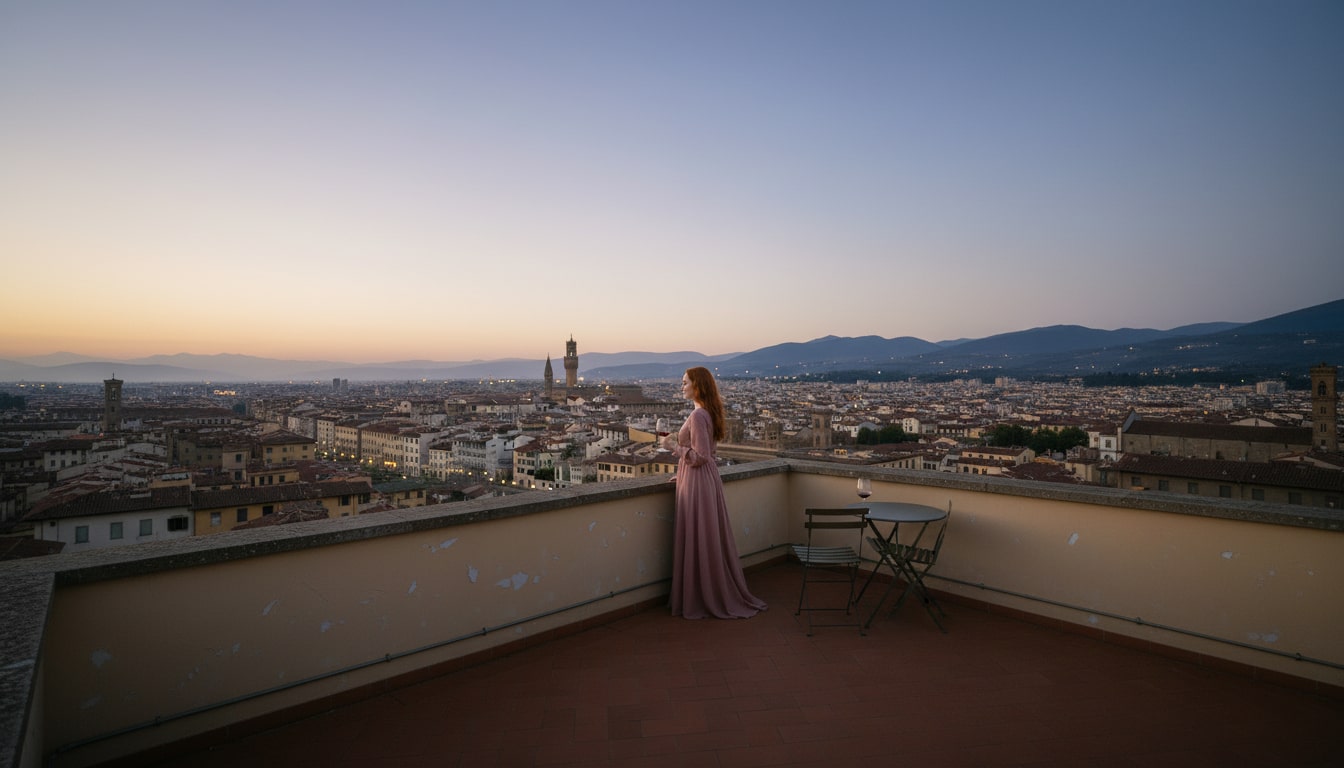
They sat on his roof terrace one October evening. The sky was violet. The bells of Santa Croce were ringing.
"Do you regret it?"
"Sometimes."
"Only sometimes?"
She smiled. "Only sometimes."
He handed her a glass of wine. They clinked glasses.
Sophia looked out over the rooftops. Somewhere out there was her old life. Berlin. The university. The person she had been.
But here she was now.
Mateo placed his hand on hers. She turned her palm upwards.
Her fingers interlocked.
The light changed. The city became darker.
It stayed warm on the terrace.