Little Italy

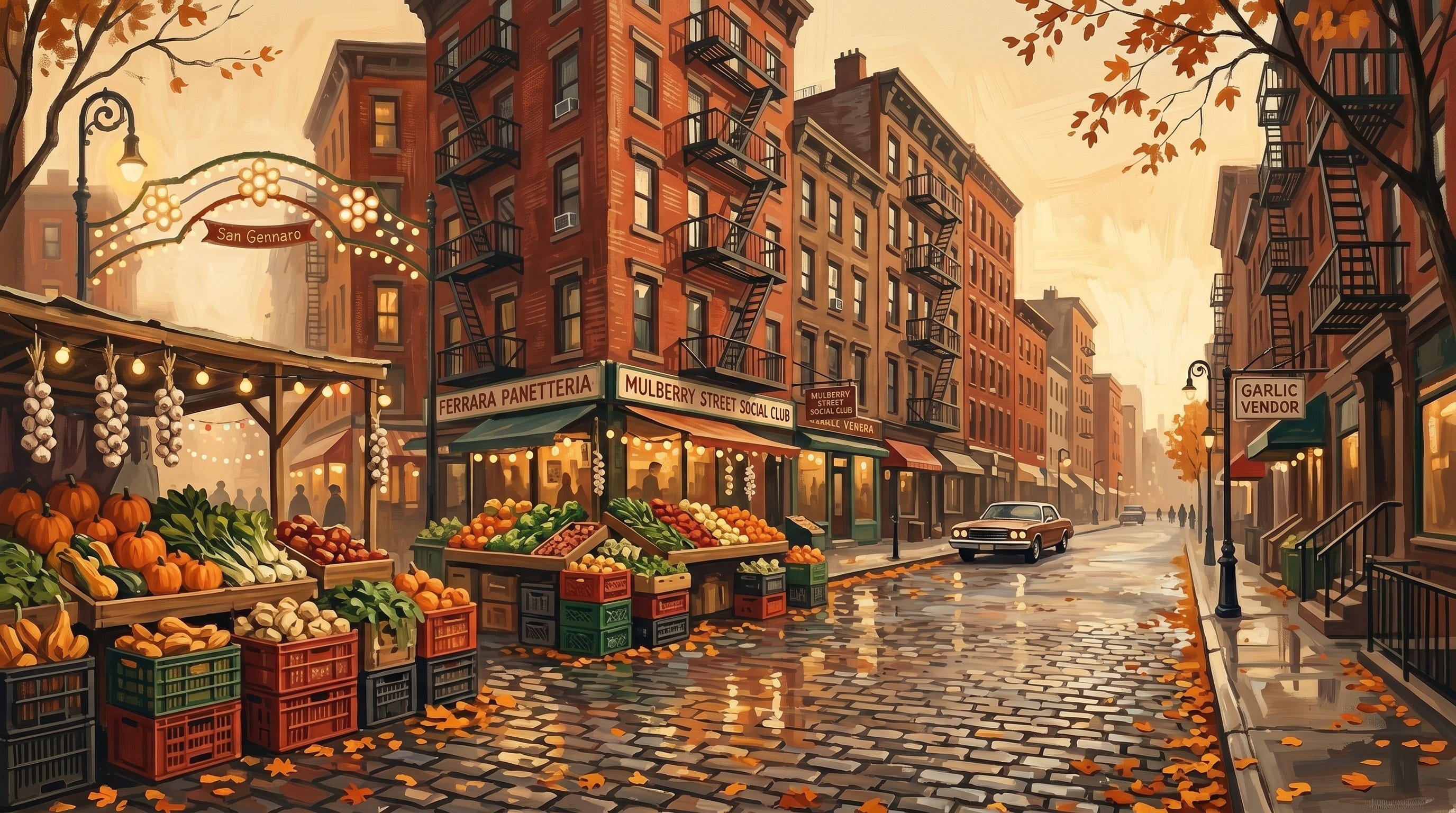
Autumn came to Little Italy like an old acquaintance arriving too early: with the smell of wet brick walls, roasted chestnuts from the stand on the corner of Canal Street, and that specific October light that bathes the facades of Mulberry Street in a honey-colored nothingness before the sun already gives up at four o'clock.
Gia Caruso had set up her stand between Lattaro's bakery and Old Enzo's newsstand the way she did everything: without permission, without apology, and with a precision that left no doubt about her intentions. Two sawhorses, a chipboard plank, three crates of vinyl in neatly greased plastic sleeves. She knew every cut on a record spine, every faded LP cover, every pressing error that tripled the value. At sixteen, she had left the name Russo in a Queens bathroom, along with everything else that had felt like someone else. Twelve years later, she stood here, and the name Caruso fit the grooves in her hands better.
Tuesday afternoon was sluggish. An older woman with a headscarf held up a Coltrane pressing, pressed the sleeve twice, and put it back. Gia let it happen. That was the rhythm: touch, hesitate, put away, remember, come back. Most of them came back.
She heard him before she saw him.
His footsteps on the pavement were barely audible, that was the strange thing. Clean leather shoes would have made a dull, regular tap. He made almost none, and yet he was suddenly there: mid-thirties, dark wool coat over a suit that actually fit as if it had been tailored for his body and no other. Hair a shade too perfectly combed back. Matteo Ferrante, she knew, because Old Enzo had given her the tip two weeks ago: That's the eldest of the Ferrantes, the one with the trattoria. He doesn't make a scene.
"Signorina." He stepped closer, without crossing the boundary her stand formed. "I believe we haven't officially spoken yet."
"No," Gia said, without looking up. She arranged a handful of singles into the second to last groove of the box. "And there's a reason for that."
"This spot belongs to my Nonna." The voice was calm, factual, without any emphasis. That made it worse. "The family has had it since 1953. There's no written agreement with the neighborhood, but there is, how shall I say—"
"Custom?"
"Tradition." He smiled, and that was the problem: It was a genuine smile. Not a tactic. Gia recognized tactics; she had studied them like printing presses and envelope colors. This was something else, and that's precisely why she immediately distrusted him.
"Traditions," she said, setting down the box and looking directly at him for the first time, "are usually just power that has invented a story for itself."
He nodded, as if it were a valid point. "Possibly."
This was wrong. He should have argued. Should have said: Nonna needs the spot back in spring, or: The neighborhood has rules. Instead, he nodded, and Gia demonstratively reached into the first record box and began restacking her crates. Loudly, on purpose.
"I'm not moving," she said. "If that was the question."
"It wasn't a question." He put his hands in his coat pockets. "I just wanted to introduce myself. Matteo Ferrante."
"I know who you are."
"And you are?"
"Gia. And you're a suit-wearing man with too much gel in his hair trying to explain to me what tradition means." She looked at him. "That's enough of an introduction for me."
Somewhere behind him, Old Enzo coughed, trying to hold the newspaper higher as if he wasn't listening.
Matteo Ferrante remained perfectly calm. He stood still, kept his voice low, offered no comment on the tempo of her judgment. He just looked at her for a moment: with something Gia couldn't place, because it was neither calculation nor amusement. Then he said, "Buonasera, Signorina."
And left.
So simple. So without residue.
Gia stared after him until the dark jacket disappeared around the corner of Mulberry Street. Then the rain started, that fine, relentless New York autumn drizzle that wasn't dramatic enough to take shelter from, and too persistent to ignore. She pulled the tarp over the first two boxes.
A man like him had no business being here.
Neither did she. That was the truth she hadn't yet allowed herself to think aloud.
She spent the night not sleeping.
The Ferrantes' attic room had sloping walls, a window squeezed into the frame like an afterbirth, and a heating pipe that began to work at half past two with a deep, soothing sound, as if the house had decided to keep her company. The record player in the corner was too good for this chamber: a Thorens turntable that someone had meticulously maintained, with a precisely calibrated counterbalance. You don't calibrate something like that if you don't care about sound. Someone in this family had taste, and Gia decided that thought was safer than any other that had intruded in the previous two hours.
It hadn't been raining anymore when Matteo came up the narrow stairs with the Chianti.
He had knocked, once, briefly, more as an announcement than a question. And Gia had opened, because she was awake anyway and because she wanted to be honest with herself in at least this regard: She had hoped he would come. A bottle of Chianti, two glasses from the restaurant that were clearly not meant for an attic room. He had set them on the floor, because there was no table, and then leaned against the windowsill, the lights of San Gennaro Street far below, the autumn pavement gleaming from the early rain.
They had talked. That had been the surprising thing: They had really talked.
About records first, that was her territory and she knew how to insist on it. She had explained to him what made the difference between a German and an American pressing of Kind of Blue, and he hadn't pretended he didn't care. Then the conversation had slid to a place she hadn't controlled: He spoke of his father, who had built the trattoria when Matteo was too young to see over the counter, and how he had learned to carry responsibility and love in a single movement, because the Ferrantes never distinguished between the two. Gia had looked into her glass and at some point said that she didn't know what it was like to belong to a place that continued to function even without you.
He hadn't answered. That was the moment she looked at him for the first time, really looked at him, without the judgment behind it.
The distance between them on the windowsill had ceased to be a distance for a while. Through the weight of silence, that was the rare thing, not through movement. When she kissed him, it was her decision, clear and unapologetic, and he accepted it like someone who had hoped for exactly that but hadn't believed it.
His mouth was slow. That was the first thing she registered. He kissed her with a precision that looked like patience and was something else entirely: no pressure, no urgency, which so often disguised insecurity. A hand on the back of her neck, flat and calm, as he led the kiss, until Gia realized she had leaned forward, that the wall was cold against her back and he was warm against everything else.
She pulled his jacket from his shoulders, button by button the shirt beneath, and he let it happen with that calm, attentive intensity that had irritated her all week. Then he pulled her sweater over her head, and the autumn air in the room hit her skin like a reminder that this was real.
He laid her back on the narrow bed, followed her, and his mouth wandered from her jaw to her neck, along her shoulder, until it stopped at her breast. He took his time with her, a nipple between his lips, tongue, steady pressure, while his hand was already on her hip, waiting. Gia closed her eyes and opened them again, because she didn't want to miss this: this man who acted as if he had all the time in the world, even though the room around them was making moves.
"Matteo." Her voice was flatter than intended.
"I know," he said, and that was all he said.
She pulled him up to her, and he correctly understood it for what it was: an instruction. The rest of their clothes disappeared without haste, without drama, a belt, denim, his trousers, and then there was no fabric between them, and he was already hard against her, his weight clear and unambiguous. She reached for him, his cock in her hand, a test on her part, and he took a short, controlled breath. The first time control slipped. She noticed it, and something in her warmed to it.
As he entered her, deliberately, inch by inch, she bit the inside of her cheek. She was wet, had been since the moment on the windowsill, but still he pulled her apart in a way that took her breath away.
He paused, even though he didn't have to pause.
That was the first thing Gia registered, even before the warmth dissolved into something coherent. He had taken her completely, deep and whole, and then he paused, and the silence between them was as thick as the wool coat lying somewhere on the floor. His breath against her temple. Her hands on his back, the muscles beneath taut.
"Gia." He said her name, just that, no sentence, no question. As if to make sure she was still there.
"I'm here," she said, and the words came before she could think about them.
Then he began to move, and the pause had served its purpose: It had allowed her to forget everything else but this moment, this room, this man. He thrust deliberately, and she felt every inch of it, the sliding, the pulling, the deep pressure in her womb that spread like heat under her skin. She arched towards him without deciding to, and he took that as the invitation it was.
The silence in the room was not empty. It was filled with the breath of both of them, the soft creak of the narrow bed, the distant hum of the city below, the occasional whistle of the heating pipe that had offered its company at half past two. Matteo moved with a patience that Gia found almost unbearable in the first few minutes, because it meant he was attentive. To her. Every reaction of her body landed in his gaze, and he adjusted, without a word.
She pulled him deeper. He allowed it.
The pace changed, gently at first, just as everything changed gently with him, and then suddenly no longer. He lifted her hips, and the angle shifted in a way that pushed the breath from her lungs. Her fingers dug into his shoulders. He thrust harder, and the room lost its contours: the sloping walls, the squeezed window, the Thorens turntable in the corner, everything contracted to a single point, to the throbbing deep within her that built like an unresolved chord.
"Matteo." This time it was her voice, saying only one word.
He understood. He reached between them, his hand where she opened, thumb on her clitoris, and the first contact made her shiver, a real shiver, not an act. He continued to move, continued to thrust, and his hand worked in a rhythm precise enough to know he had long possessed this knowledge of women's bodies, but attentive enough to realize that this body was different from all others. Her body.
She came before she was ready.
That was the right thing about it: She wasn't ready, and it still came, a wave that started in her stomach and spread to her thighs, her knees, down to her toes pressing against the sheet. She made a sound she didn't recognize, rougher than expected, and he didn't let up, he moved through the climax, held her pelvis with one hand until she stopped trembling and he himself stopped controlling. His breath broke. He pressed his face into her neck and followed her, the last thrust deep and involuntary, and she held him as he trembled, because it was natural to hold him.
Afterwards, they stayed like that.
His weight on her, heavy and warm, the thud of his heart against her chest. Outside, a cloud passed over the narrow window, and for a moment the room grew darker, softer, as if the city had decided to be discreet.
Gia reached out a hand and placed it on his back. Flat, calm. Without a plan.
That was the new thing.
She had never held anyone like this. She had known bodies, known nights, the pleasant shutting down of thought. This was different. This was: wanting to stay, even if her mind was already starting to climb the walls.
He rolled to his side, but stayed close, his hand on her hip. The room smelled of wine and autumn and them.
"You can go if you want," she said.
It wasn't a test. She meant it.
"I know," he said.
He stayed.
The light in the room didn't change. The heating pipe knocked once, twice. Somewhere downstairs in the trattoria, someone closed a door: the familiar sound of a house that knows about its inhabitants. Gia heard it and thought: This is the first time in years that I've heard a house and haven't felt like a tenant sitting in it.
Morning came with the smell of freshly ground coffee and warm bread, and Gia lay there for another moment, eyes closed, as if she could breathe in this place forever.
Matteo was already awake.
She noticed it by the way his breathing lay: too even for sleep, too conscious. He was staring at the sloping ceiling, one hand on his sternum, and Gia watched him for a moment before sitting up. The light was still thin, the morning only half-finished, and through the narrow window the smell of coffee drifted up like an invitation that came from the lower floors of the house and wanted to go nowhere else but here.
"Your Nonna makes coffee at six," she said.
"At half past five." He turned his head to her, and his gaze was open in a way Gia hadn't seen in him before: awake, but without the careful surface he wore during the day like his wool coat. "Every morning since 1962. The house smells of her."
Gia stood up and pulled his shirt on, which had been on the floor. It smelled of him, of wine and autumn, and that was information her body stored before she could decide if it was a good idea.
"I'm going downstairs," she said.
He said nothing. Watched her.
The kitchen was small and complete. That was the word for it: complete. Copper pots on hooks above the stove, a table with a wine-red oilcloth, cups that differed from each other and yet belonged together because they all came from the same cupboard. Nonna Ferrante stood with her back to her at the stove, in a blue dressing gown, white hair in a careful knot, and turned around as if she had been expecting Gia's step on the bottom stair.
She said, "Siediti." Sit down.
Gia sat down.
Nonna Ferrante placed a cup before her, black, without asking, and then a second one for the place opposite her, and that was all that needed to be said. When Matteo appeared in the kitchen doorway two minutes later, jacket in hand, shirt collar open, his Nonna gave him a brief look and then turned back to the stove. No comment. No smile that would have meant too much.
He sat opposite her, and Gia looked at her cup.
"I don't know what this is," she finally said, quietly enough for Nonna Ferrante to hear it and still pretend she didn't.
Matteo cupped his mug with both hands. "I don't know either."
"I don't have a fixed abode. I sell records on a folding table on a street that isn't mine."
"The spot is free until May," he said. "Officially."
She looked at him. He returned her gaze, calm and direct, without tactics, just as he had been all week, and Gia realized that this was the hardest part: He wasn't negotiating. He was offering her a place where she could stay without having to give up anything she couldn't yet name. This place was not just the folding table on Mulberry Street.
She reached out her hand, across the table, and placed it on his.
Matteo turned his hand over and closed his fingers around hers. Firm, but without pressure. As if he had always known this and was just waiting for her to know it too.
Nonna Ferrante placed a plate of bread on the table without a word, sat down at the head of the table with her own cup, and the Ferrantes' breakfast began.
Gia Caruso ate bread in a kitchen that smelled of coffee and old copper, while an October was just beginning outside, and for the first time in twelve years, the house she sat in had no exit she had already mapped in her head.