
Flamenco and Ashes

Read it yourself
The heat hung heavy over Seville, as if it were a substance in itself—dense, golden, inescapable. Maria felt it on her skin before she even opened the studio door. Outside, the afternoon blazed like an open flame, and somewhere in the distance, a radio played—Rocío Jurado, her voice full of drama and longing. Inside, the air smelled of wood, sweat, and the sweet, bittersweet aroma of coffee left too long on the stovetop.
She tied her hair back tightly, as always before training. The movement was ritual. Control. Her fingers pulled the knot tight until her scalp was taut. Only then could she breathe.

The mirror on the wall reflected a woman she sometimes didn't recognize. Strong, yes. But also tired. Not from work—she loved that. Tired of the men who thought they understood what it meant to be a flamenco dancer. Who thought the passion on stage was an invitation. A promise.
The day before yesterday, it had been another one. Carlos, a businessman from Madrid, suit too tight, smile too wide, hair glossy with brilliantine. He had waited by the cloakroom after the performance, a box of chocolates in his hand. "Señorita Maria, you were divine. May I treat you to dinner? To the best restaurant in town." She had smiled at him politely, but her eyes had remained cold. "Thank you, but no." "Just a drink then? A glass of wine?" "No." "But—" "I said no." Her voice was firm, final. She had no time for men like him—men looking for a trophy, something exotic for their collection. Carlos's smile was frozen. "You shouldn't be so arrogant. Women your age—" "Good night." She had closed the door in his face. She had given the chocolates to one of the younger dancers later.
The studio slowly filled up. The other dancers came in, laughing and talking about their weekends. Maria smiled back and nodded, but her thoughts were elsewhere. Always elsewhere.
She was thirty-three. Too old, some said, to still hope for great love. Too sharp, others said, too unyielding. Spain was changing—Franco had been dead for just a year, and everywhere you could feel this cautious hope, this fear of freedom. But the men? They hadn't changed yet. They still wanted the fire on stage and the subservience at home. Maria didn't give in. That was the problem. Or maybe it was the solution. She didn't know anymore.
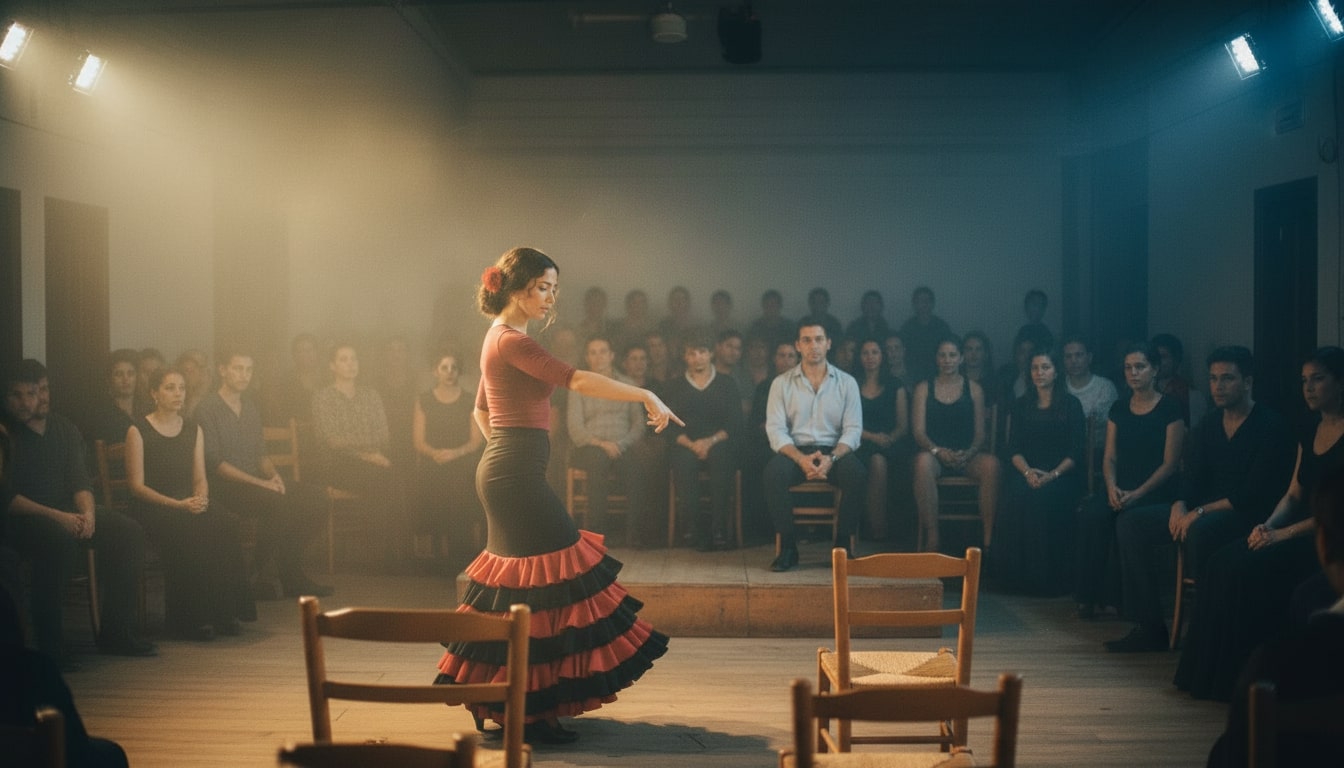
The music began—a guitar, deep and raw, like a voice that had been silent for too long. Maria closed her eyes. Let the melody flow through her body. Here, in this moment, there were no questions. Only rhythm. Only the earth beneath her feet, the air in her lungs, the pounding of her heart against her chest. When she danced, she was free.
When she stopped, the sadness returned.

She saw him for the first time on a Thursday evening.
She saw him for the first time on a Thursday evening.
The tablao was packed, as always. Tourists, locals, a few businessmen who had come after work to forget themselves. The smoke from a hundred cigarettes hung in the air like a veil. Maria no longer recognized these faces. They had blurred into a single, anonymous mass.
But not him.
He sat in the third row, to the left of the stage. Alone. No glass in his hand, no cigarette nervously twirling between his fingers. Just him and the music. He didn't look like the others—not with that hungry, judgmental gaze she knew. He looked at her as if trying to understand something. As if she were a language he didn't yet master, but wanted to learn.

And he didn't just see her as a dancer. She sensed that immediately. His gaze didn't linger on her body, not on the dramatic pose, not on what she was portraying . He saw her . The woman behind it. The anger in her movements, the loneliness she poured into every step.
French, she thought later. Something about his posture, the way he held his head. Reserved, yet present.
After the performance, she didn't go straight to the dressing room. She stood at the bar and ordered a glass of wine, even though she didn't actually want one, just to see if it was still available.
He was there.
He drank water. No beer, no wine. Just water from a simple glass, slowly, deliberately.
Maria looked away before he could notice him. But it was too late. She had already felt something shift inside her. A small, dangerous movement, like the first tremor before an earthquake.
They met three days later. By chance, she thought at first. But Seville was small, and chance here always felt a bit like fate.
It was at the Triana market, among the stalls of oranges and olives, where the air smelled of salt and earth, and vendors hawked their wares in that fast, melodic Andalusian dialect that sounded like song. Maria bought tomatoes, held one in her hand, checked its weight, its firmness. When she looked up, he was standing two meters away, a paper bag of bread under his arm.
"They dance beautifully," he said in Spanish. He had an accent, yes, but it was soft. Respectful.
Maria put the tomato back. "Thank you."

“I’m Matthieu.” He didn’t extend his hand. Good. She hated those false gestures of politeness, which were really just possessive claims.
"Mary."
"I know."
That could have sounded pushy. But it didn't. It just sounded honest.
"Do you often come to Seville?" she asked.
"Too often, perhaps. For business reasons."
"What kind of businesses?"
"Import, export. Textiles, mainly. Between France and Spain." He didn't smile. As if it were just information, nothing important. "But that's not why I'm here."
"What is the reason?"
He hesitated. The air between them grew thicker, like before a thunderstorm.
“The city,” he said finally. “And the people who know how to live. Who don’t pretend that everything is a performance.”
Something in his tone of voice caught her attention. No come-on. No polished phrase. Just an observation he shared with her as if they were old friends.
Maria felt something loosen in her chest. Not much. Just a small piece. But enough to frighten her.
"I have to go," she said.
He nodded. "Of course."
She left. But she could still feel his gaze on her back for a long time. Not intrusive. Just... present.
In the following weeks, she saw him more often. Never planned. Never intrusive. But there he was.
Once, in Café Central, where she drank her morning cortado and read the newspaper—El País was just a year old, and Maria devoured every article about the new Spain slowly emerging from Franco's shadow—Matthieu sat by the window, reading Le Monde, a cigarette between his fingers. They exchanged a glance, a brief smile. Nothing more.
Another time, on the Guadalquivir, in the evening, when the sun was setting and the water shimmered golden like liquid metal. The Torre del Oro glowed in the evening light, and the air smelled of orange blossoms and the distant sea. He stood at the railing, his hands in the pockets of his faded jeans, and gazed at the water as if he had all the time in the world.
Maria stopped. She wanted to continue walking. But her feet wouldn't obey.
"They think a lot," she said.

Matthieu turned to face her. Slowly. As if he knew she was there. His eyes were almost black in the dim light, and they held a depth that surprised her every time – no superficiality, no masculine posturing. Just attention. Real, undivided attention.
"Sometimes that's all you can do."
"And sometimes," Maria said, "it's better not to think."
"How do you feel when you dance?"
She nodded.
"I envy you for that."
"Why?"
"Because you know how to stop thinking. I never learned that." He took a drag on his cigarette, and Maria watched as his lips touched the filter. "And because you're not afraid of being seen. On stage. You don't hide."
That was it. That was what set her apart from all other men. He saw her. Not just her body, not just the dancer, not just the beautiful woman with the wild eyes and the proud gait. He saw something in her that she herself sometimes forgot – her boldness, her uncompromising nature, the way she refused to diminish herself. And he also saw her loneliness, without pitying her for it.
Most men wanted to either tame her or conquer her. Matthieu just wanted to... understand.
Maria stepped closer. Not much. Just one step. But it felt like a jump.
"Perhaps," she said softly, "you don't have to learn it. Perhaps you just have to allow it."
He looked at her. For a long time. Too long. And Maria felt her heart pounding against her ribs, as if it wanted to burst out.
Then he looked away. "I think I'm afraid of it."
"Afraid of what?"
"Before what will happen if I let go."
Maria smiled. Not happily. Just with recognition.
"Me too," she whispered.
The conflict did not begin as an argument. It began as silence.
They met often. Strolls through the old town, through the Barrio Santa Cruz with its narrow streets and whitewashed walls, where geraniums hung from terracotta pots and old women dressed in black sat in front of their doors, observing everything. Conversations about politics—the uncertainty after Franco, the hope for democracy, the fear of what was to come. About art, about the feeling of freedom that they both sought and feared.
Maria felt something growing inside her – something soft, dangerous. The desire to lean on something. To let herself fall.
But every time she came too close to fulfilling that desire, something inside her tensed up. Panic. Resistance.
She wasn't a woman who leaned on men. She was a woman who stood alone. That was her identity. Her strength.
But with Matthieu, this strength sometimes felt like a burden.
One evening, after a performance, he invited her to dinner. A small restaurant, tucked away in a side street, where the walls were covered with old azulejos – blue and yellow tiles that told stories of Moors and kings. The wine tasted of earth and sun, and soft music drifted from the radio in the corner – Paco de Lucía, his guitar playing like water flowing over stones.
They talked about music, about travel, about how cities change and how people stay the same. But beneath the words lay something else. A question none of them asked.
“Why are you alone?” Maria finally asked.
Matthieu held his glass in his hand, turning it slowly. The light from the candle on the table refracted in the wine, casting red shadows on his fingers.
"Because it's easier," he said. "Because I'm not good at staying with someone."
"Why not?"
"Because I'm afraid that if I do it, I'll disappear. That I won't be myself anymore."
Maria felt her throat tighten. "And when you're alone? Are you yourself then?"
He smiled. Sadly. "No. Then I'm just safe."
She understood him. More than she wanted to.
“I am alone too,” she said quietly. “But not because it’s easy. But because I haven’t found anyone who… who is strong enough to withstand my strength.”
Matthieu looked at her. For a long time.

“Perhaps,” he said, “you are looking for someone who can’t stand you. But someone who sees you.”
Maria bit her lip. The words had cut too deep.
"And what if I don't want to be seen?"
"Then you're in the wrong place."
He didn't say it harshly. Just the truth.
Maria stood up. Not out of anger. Only because she didn't know how to stay seated without falling apart.
"I have to go."
Matthieu nodded. "I know."
But this time he didn't stop her. And that was worse.
Three weeks passed. Maria danced. Trained. Lived her life as she always had. But something had changed. The music sounded different. Quieter. As if it had lost its essence.
She thought of Matthieu. Every day. Every night. Thought of his words, of the way he had looked at her. Not like a man desiring a woman. But like a human being recognizing another human being.
And she hated it. Hated how much she missed him. Hated how this loss showed her that she wasn't as strong as she thought.
One evening, after a performance, he was back in the audience.
In the back, in the last row. Almost in the shade, a cigarette between his fingers.
Maria saw him immediately. Her heart skipped a beat. But she kept dancing. Danced harder. As if she could dance him out of herself.
After the performance, she didn't go to the dressing room. She went straight to him.
He stood up as she approached. He stubbed out his cigarette in an ashtray. Said nothing. Waited.
"Why are you here?" Maria asked. Her voice trembled, but she met his gaze.
"Because I missed you."
"That's not an answer."
"Yes. It's the only answer that matters."
Maria swallowed. The air between them was electric. Too close. Too far.
“I can’t…” she began. But she didn’t know how to end the sentence.
Matthieu took a step closer. Not too close. Just close enough for her to feel his warmth, the scent of tobacco, and a subtle eau de cologne that smelled of lemon and wood.

"I don't ask anything of you, Maria," he said softly. "I just want to be with you. Just as you are. Strong. Alone. Whatever you need."
"And what if I don't know what I need?"
"Then we'll find out together."
Maria felt something open in her chest. Slowly. Painfully. Like a scar beginning to heal.
"I'm scared," she whispered.
"Me too."
She laughed. Softly. Fragilely. "What a couple we would make."
“Perhaps,” said Matthieu, and his hand rose, hesitantly, gently touching her cheek, “that’s just right.”
They didn't go home. Not right away. They walked through the city, through the narrow streets where the air smelled of jasmine and old stone, where cats scampered over the walls, and somewhere someone was playing a guitar, softly and melancholically. They didn't talk much. But the silence was no longer heavy. It was soft. Almost tender.
Eventually they stopped. At a small church in the Plaza de Santa Cruz, its door standing ajar. Inside, candles burned, casting flickering shadows on the walls, and the scent of incense still lingered in the air from the evening mass.
Matthieu looked at her. "May I hold your hand?"
Maria hesitated. Then she placed her hand in his.
It was just a touch. But it felt like a decision.
"I don't know where this is leading," she said quietly.
"Nobody needs to know that."
"But I... I still have to stay me. Do you understand?"
“Yes.” Matthieu squeezed her hand gently. “And I don’t want you to change either. I just want… you to stay. And for me to be allowed to stay.”
Maria closed her eyes. She felt the warmth of his hand, the coolness of the night air, the smell of wax and smoke.
And for the first time in a long time, she felt that it might actually be possible. To be strong and yet let go. To be alone and yet not lonely.
She opened her eyes. Looked at him.
"Stay a little longer," she said.
Matthieu smiled. "For as long as you want."
Then he leaned forward, slowly, giving her all the time in the world to say no. But she didn't say no. Instead, she lifted her face, and when their lips met, it was like a promise.
The kiss was gentle. Not demanding, not passionate. Just two people who had found each other in the darkness and decided not to run away anymore.
When they broke apart, Matthieu laid his forehead against hers.
"Maria," he whispered.
"Yes," she whispered back. "Yes."
And in that moment, beneath the flickering candles, in the warm, heavy air of Seville, something within Maria dissolved. Not everything. Not all at once.
But enough to breathe.
Enough to give hope.
Enough to know that the question didn't need to be answered. Not today. Maybe never.
Some things remained unresolved. And that was okay.
That was actually nice.
✧ Text, images and narration of this story are created with the help of AI. Curated and edited by Narrabelle. How we work


